
Missoui Mortgage Loans: Complete Guide to Home Financing
Missoui Mortgage Loans: Complete Guide to Home Financing
Exploring Missouri’s mortgage options might seem overwhelming at first, but learning about your choices can turn a complicated process into a smooth journey. Whether you’re a first-time buyer, a veteran, or simply searching for an affordable new home, Missouri has a program tailored to your needs.
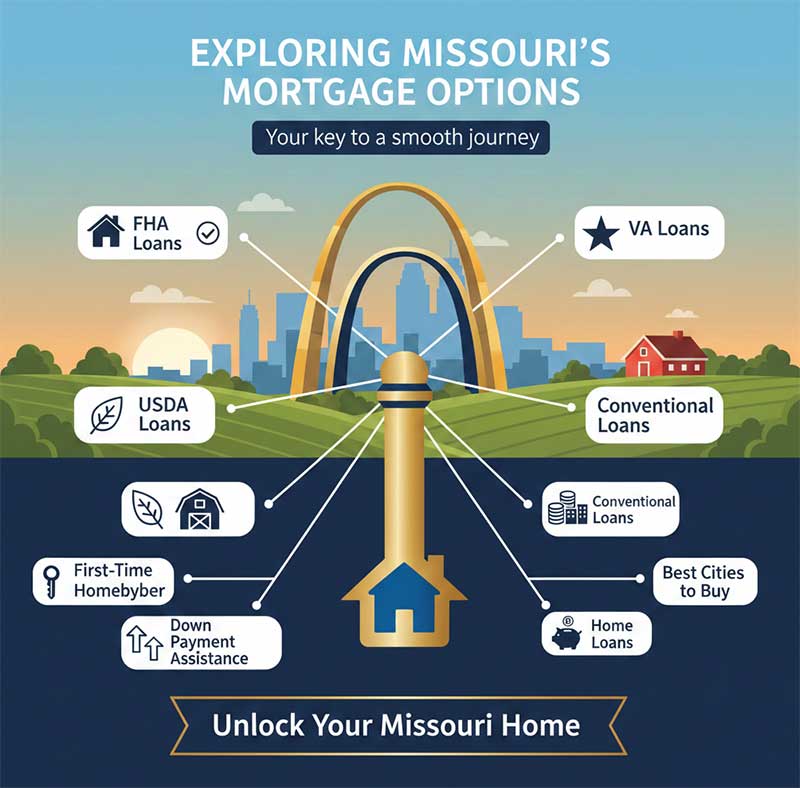
Learn about Missouri mortgage loans and programs: FHA, VA, USDA, conventional, non-QM, first-time homebuyer, down payment assistance, new to Missouri, and best cities to buy a house and home loans.
From cozy rural starter homes to grand estates in St. Louis, Missouri’s housing market has something for everyone. Finding the right mortgage is the key that unlocks your path to homeownership.
Options On Type Of Missouri Mortgage Loans
There are many types of mortgage programs for Missouri homebuyers, each with its own benefits and rules. The best one for you depends on factors such as your credit score, job or military service, income, where you want to live, and how much you can pay up front. Missouri residents can choose from FHA, VA, USDA, conventional, Non-QM, and Jumbo loans. These options are available throughout the state and work for almost every type of homebuyer and property.
FHA Loans in Missouri
FHA loans are a popular choice for many Missouri first-time buyers and people working to improve their credit. FHA home loans are government-backed loans let you pay less up front and have easier credit requirements than regular loans. Missouri residents can use an FHA loan if their credit score is 580 or higher, requiring a down payment as low as 3.5%. If the score is between 500 and 579, borrowers must pay a 10% down payment.
FHA loans are a good option for those who have had credit issues but have recently shown good financial behavior. With an FHA loan, Missouri residents can buy a single-family home, a small apartment building with up to 4 units, a condo, or a manufactured home that meets FHA rules.
The amount you can borrow with an FHA loan depends on the county. Most counties have lower limits, but some more expensive areas let you borrow more.
When you finish buying a home with an FHA loan in Missouri, you pay an upfront mortgage insurance fee, usually 1.75% of the loan amount, which can be added to your loan. You also pay a yearly fee as part of your monthly payments. For people with little savings or past credit problems, FHA loans often make it possible to buy a home.
Ready to Buy a Home in Missouri?
Call Gustan Cho Associates at 800-900-8569 or apply online to see what you qualify for in Missouri today
VA Missouri Mortgage Loans
Missouri service members, veterans, and eligible surviving spouses can access VA-backed loans. VA home loans are often more affordable for those who have served. A key benefit of VA loans in Missouri is that they require no down payment. This allows veterans and service members to finance 100% of the home’s sale price and purchase homes without needing to save extensively for a down payment.
VA loans in Missouri do not require private mortgage insurance and usually have lower interest rates than regular loans. This helps keep monthly payments and long-term costs lower for those who qualify.
There are many military families and veterans living in Missouri, especially in areas close to Fort Leonard Wood, Whiteman Air Force Base, and the St. Louis and Kansas City areas. Numerous VA-approved lenders in Missouri assist veterans throughout the loan process, from obtaining a Certificate of Eligibility to closing. There are also VA streamline refinancing and cash-out refinancing options that allow veterans to refinance their mortgages, giving them more flexibility in homeownership. People in Missouri communities near military bases and in areas with many veterans use VA loans the most. Fort Leonard Wood and Whiteman Air Force Base are the main reasons Franklin, Pulaski, and Johnson Counties have high VA loan usage. Both St. Louis and Kansas City have significant VA loan activity due to their large veteran populations.
Jumbo Missouri Mortgage Loans
Jumbo loans make up a smaller but important slice of Missouri’s mortgage market, especially in upscale areas like Ladue, Clayton, Town and Country, and the luxury communities around the Lake of the Ozarks. Missouri’s mortgage trends show that the best loan is the one that fits your unique needs, goals, and plans—not just what’s popular. Personal circumstances should always guide your decision.
USDA Rural Development In Missouri
USDA loans, backed by the U.S. Department of Agriculture, help people buy homes in Missouri’s suburbs and rural areas. USDA rural development loans let eligible buyers purchase a home with no down payment, making it easier to own a home in rural places. Many are surprised to learn that USDA loans aren’t just for farms—suburbs near Missouri’s big cities and plenty of small towns also qualify. Homebuyers can easily check property eligibility using the USDA’s online map.
To get a USDA loan in Missouri, your household income usually must be no more than 115% of the average income in your county. The exact limit depends on your family size and where you live.
In applying for a USDA loan, borrowers may find that credit score requirements are quite relaxed, as most lenders accept credit scores as low as 640. These loans favor applicants with stable employment, reasonable debt-to-income ratios, and a record of financial responsibility, making them accessible to families with previous financial challenges. upfront guarantee fee equal to 1% of the loan amount. This can be added to the loan. Then, the borrower pays an annual fee divided into monthly payments. Competitive interest rates and no-down-payment options make USDA Missouri mortgage loans the most affordable for eligible homebuyers in Missouri.
Conventional Loans in Missouri
Conventional loans are the most common choice for Missouri homebuyers, especially those with good credit and steady finances. These loans are not backed by the government, so borrowers have more choices and flexibility. In Missouri, conventional loans can be conforming, which means they meet the loan size limits set by Fannie Mae and Freddie Mac, or non-conforming, which means they exceed those limits. The maximum size for conforming loans changes by county. Most counties have a standard limit, but some more expensive areas have higher limits.
First-time buyers in Missouri may qualify for a conventional loan with just 3% down, though many choose to put down more—5%, 10%, or even 20%—to lower their payments and skip private mortgage insurance.
If you put less than 20% down on a conventional loan in Missouri, you’ll pay PMI until you reach 20% equity. The good news: PMI can be dropped once you’ve built enough equity, unlike FHA mortgage insurance. Most conventional loans in Missouri require a credit score of 620 or higher, and you get better rates if your score is above 740. Lenders also consider your debt-to-income ratio, job stability, savings, and overall finances. These loans can close faster and have fewer property rules. They also let you borrow more money than government-backed loans. For Missouri residents with good credit and savings, conventional loans are often the most affordable choice.
Non-QM Missouri Mortgage Loans
Non-Qualified Mortgages (Non-QM) are available to Missouri residents who do not meet the requirements for conventional, FHA, VA, or USDA loans. These loans use different approval rules that work for people with unusual finances or paperwork. Non-QM loans are helpful for Missouri real estate investors, self-employed individuals, business owners, and anyone with complex finances. These loans may use bank statements or other proof of income instead of regular pay stubs and tax returns.
If you have a bankruptcy, foreclosure, or short sale in your past, non-QM loans may be easier to get than regular loans. Even though non-QM loans often have higher interest rates and bigger down payments, they can help people who need more time to fix their credit.
Non-QM loans in Missouri are made to be flexible. They can be used for special property types, interest-only payments, and even for buyers from other countries. This flexibility helps meet the needs of many different homebuyers in Missouri. It is important to work with experienced non-QM lenders in Missouri and carefully review loan offers. Borrowers should compare fees, terms, early payment penalties, and rules before choosing a non-QM loan.
Bad Credit or Low Scores in Missouri?
Reach out today and let us review your file for FHA, VA, conventional, USDA, jumbo, and non-QM Missouri mortgage loans with no lender overlays on government loans
Jumbo Missouri Mortgage Loans For Luxury Properties
Some areas need jumbo loans, which exceed the limits set by Fannie Mae and Freddie Mac. Jumbo mortgages in Missouri are used for expensive homes in places like Clayton, Ladue, Town and Country, the Lake of the Ozarks, and other high-end communities. Jumbo loan limits in Missouri change by county. Any loan bigger than the local limit is called a jumbo loan.
Because Jumbo Missouri mortgage loans are riskier for lenders, they have tougher approval rules than regular loans. Most people who get jumbo loans in Missouri have high credit scores, usually 700 or higher, and the best rates go to those with scores above 760.
Lenders look closely at your debt-to-income ratio, usually wanting it to be 43% or less. Down payment amounts can vary, with some programs allowing 10% down for people with excellent credit and lots of savings. People applying for jumbo loans in Missouri need to show they have extra money saved, usually enough to cover 6 to 12 months of mortgage payments, plus the down payment and closing costs. Even though Missouri jumbo loans have tougher rules, they can still help people buy expensive homes and may offer good interest rates to those who qualify.
Down Payment Assistance Missouri Mortgage Loans
To help renters become homeowners, the Missouri Housing Development Commission offers programs that provide education, low-interest rates, and down payment assistance. In Missouri, first-time homebuyers are those who have not owned any property in the last 3 years. This means people who have owned property before but are renting now are still considered first-time homebuyers. Because of this, many people in Missouri are unaware of first-time homebuyer programs.
Missouri First Place Loan Program
The Missouri First Place Loan Program offers St. Louis first-time homebuyers down payment assistance along with affordable thirty-year fixed-rate mortgages. Missouri’s first-time homebuyer programs are income-based, and the limits are determined by the county and the household size. These limits are designed to help those who need affordable homeownership help the most. There are also county-based purchase price limits based on each Missouri county’s housing market.
Missouri Down Payment Assistance Missouri Mortgage Loans
Missouri’s Down Payment Assistance Program can be a game-changer for first-time buyers with steady incomes but little saved. This support helps families break free from renting and step into homeownership.
State programs aren’t the only resource for Missouri’s first-time buyers. Cities like Kansas City, St. Louis, Springfield, and Columbia offer their own assistance, including down payment help, forgivable loans, and tax breaks.
Many Missouri assistance programs require first-time buyers to take homebuyer education courses. These classes, available online and in person, cover everything from mortgages to maintenance and budgeting—preparing you to enjoy the rewards and responsibilities of owning a home.
Most Accessible Missouri Mortgage Loans
If you’re looking for the easiest path to a mortgage in Missouri, FHA and USDA loans are your best bet. With lower credit score requirements, flexible debt-to-income ratios, and smaller down payments, these programs open doors for many buyers. FHA loans in Missouri allow credit scores as low as 580 and down payments as low as 3.5%.
FHA loans makes them possible for many people who have had credit problems. The FHA loan program’s approval rules are more flexible and look at your whole credit history.
This means you can qualify even with a lower score if you have managed your money well recently. USDA loans make homeownership possible for more Missouri families by offering zero-down-payment financing for rural properties. While there are income and location rules, many buyers find USDA loans easier to secure—especially with the help of experienced local lenders. For Missouri’s veterans and service members, VA loans offer the smoothest route to homeownership—no down payment, no set minimum credit score, and flexible qualifications. Military families often find that these loans make buying a home far more attainable.
Non-QM Missouri Mortgage Loans
For Missouri borrowers, non-QM loans may be the easiest to qualify for, even though they usually require a larger down payment. Self-employed people, those with credit problems, and those with complex income often find that non-QM loans have more flexible approval rules than regular mortgages.
Boost your chances of getting approved by teaming up with experienced Missouri lenders who offer a range of loan programs. A knowledgeable loan officer can help you find the best fit for your finances and goals.
Most Affordable Cities and Counties in Missouri to Buy Homes
With home prices spanning a wide spectrum, Missouri’s cities and counties offer plenty of value for buyers. Finding the right spot can help you make the most of your budget and reach your homeownership dreams. Cape Girardeau stands out as one of Missouri’s most affordable cities, thanks to its budget-friendly home prices, low property taxes, and stable economy. Nestled along the Mississippi River, it offers a welcoming small-city vibe, excellent schools, and a cost of living that keeps expenses in check.
Joplin, in Southwest Missouri, boasts home prices below state and national averages and a modern housing market. After rebuilding from the 2011 tornado, Joplin has emerged stronger, with a thriving economy anchored by healthcare, education, and manufacturing.
Jefferson City offers affordable homes, steady government jobs, and great schools. Compared to larger cities like Columbia, St. Louis, and Kansas City, it has lower housing costs but still offers access to city amenities. Missouri’s third-largest city is Springfield, which offers a variety of homes, both old and new, as well as cultural and city attractions. Joseph, just an hour north of Kansas City, blends big-city perks with small-town charm. Here, you’ll find job opportunities, entertainment, an international airport, and homes that won’t break the bank. Across Missouri, programs offering financial aid for down payments are available.
Missouri’s Programs for Financial Aid on the Down Payment
Homebuyer assistance programs in Missouri help people buy homes by making it easier to save enough money. These programs use grants, loans you do not have to pay back, and loans you can pay back later to help with down payments and closing costs.
- The Missouri Housing Development Commission offers the state’s largest down payment assistance program, providing eligible buyers with up to 4% of their loan amount (up to $7,500) for down payments and closing costs.
- This help is available through the First Place Loan program and includes a homebuyer education course.
- Kansas City also provides down payment help through the KCMO First-Time Homebuyer Assistance Program.
- This program helps provide eligible homebuyers within city limits $7,500 in forgivable loans.
- This program is aimed at low- and moderate-income families and requires homebuyers to continue occupying the home as their primary residence for a set period to receive full loan forgiveness.
The St. Louis Development Corporation
The St. Louis Development Corporation is the organization in St. Louis that provides assistance with mortgage down payments. The organization can help with payments through partnerships and programs focused on revitalizing and restoring homeownership in specific neighborhoods receiving reinvestment. These programs are able to help with ‘‘more generous payments in exchange for commitments to keep the properties bu. St. Louis Columbia also offers down payment assistance.
The City of Columbia offers down payment assistance in the form of forgivable loans to help buyers purchase homes in targeted investment areas. These loans promote neighborhood stabilization and homeownership growth.
The program integrates with the federal HOME Investment Partnerships program to optimize the available funding for Columbia homebuyers. A majority of Missouri counties offer down payment assistance programs funded by federal Community Development Block Grants and HOME funds, paired with local funding. These counties include Jackson County, St. Louis County, Jefferson County, and others that provide funding to help residents purchase homes.
Missouri Mortgage Loans: Employer Assisted Housing
Employer-assisted housing programs in Missouri offer another way to get down payment help. Major employers like BJC HealthCare and Washington University provide grants to employees buying homes in certain areas, supporting both staff retention and community growth. Before applying for down payment assistance in Missouri, be sure to check the details—like income and purchase price limits, education requirements, and any recapture rules. Some programs require repayment if you sell too soon, while others offer full forgiveness after you’ve lived in the home for a set time.
Denied by a Missouri Bank or Credit Union?
Contact Gustan Cho Associates and let us re-underwrite your Missouri mortgage file using flexible, common-sense guidelines and national investor options
Missouri Housing Assistance Programs
Besides down payment assistance, Missouri has many other programs to help people buy, keep, and maintain homes. Knowing about these programs helps more people in Missouri become homeowners. Missouri’s rural counties often feature the lowest property taxes and home prices around. Many buyers are drawn to these areas for the extra space, bigger lots, and the tranquility of country living. When searching for affordable places in Missouri, look beyond just the sticker price. Consider property taxes, insurance, commute times, schools, and job prospects. Sometimes, a bargain home isn’t the best value if it means long drives or limited opportunities.
The Missouri Property Tax Credit Claim
The Missouri Property Tax Credit Claim provides relief to qualifying homeowners and renters. Income and age criteria apply. These property tax credits help vulnerable Missouri residents who are seniors, disabled, or veterans with a limited income, and are financially able to leave home ownership’s burdens behind. Missouri’s Homestead Preservation program helps homeowners who are at risk of losing their homes due to financial problems, such as job loss or a medical emergency. The program gives short-term loans to help people catch up on their mortgage and keep their homes.
The Missouri Section 8 Homeownership Program
The Missouri Section 8 Homeownership Program allows some Section 8 voucher holders to shift their housing assistance from mortgage assistance to paying a mortgage. This program provides a rental assistance shift to homeownership. This facilitates the creation of equity and financial stability as the supported families receive housing assistance. Habitat for Humanity Missouri has affiliates that offer homeownership opportunities through sweat-equity programs. Partner families receive no-interest mortgages and affordable pricing through the receipt of custom-built homes and the donation of hundreds of their own labor hours to build homes for others. Missouri has several Habitat affiliates that serve communities across the state.
The Missouri Housing Development Commission
The Missouri Housing Development Commission oversees the Mortgage Credit Certificate program. Under this program, first-time homebuyers receive a federal tax credit equal to a percentage of their annual mortgage interest. This tax credit offsets a federal tax liability, reduces the income available for mortgage payments, and thereby enhances mortgage qualifying.
Missouri has emergency repair programs for low-income homeowners to fix important health and safety problems, like roof, heating, or electrical issues, and to add features for people with disabilities.
These programs help older and disabled homeowners stay safely in their homes and keep their homes in good condition. Missouri’s weatherization assistance helps homeowners save money by adding insulation, sealing drafts, upgrading windows, and tuning up furnaces. Lower energy bills mean more affordable, stable housing—especially for families on a tight budget.
Most Popular Missouri Mortgage Loans
Missouri’s wide range of mortgage options, housing markets, and buyer backgrounds means different loans are popular in different places—each reflecting a unique path to homeownership. Conventional loans make up a big portion of Missouri’s mortgages, especially in the state’s larger cities and counties like St. Louis, Jackson, and St. Charles.
FHA home loans are most accessible to new buyers with low credit scores or who are simply short on the cash required for a down payment, which are the segments Missouri buyers fall under.
These areas have home prices and buyer credit scores that meet conventional loan requirements, which drives their popularity. Missouri buyers are eligible for FHA loans. There are also many FHA loans available in Missouri’s lower-priced counties and among young buyers seeking homes.
Missouri Mortgage Loans: Getting the Best Interest Rate
Since your mortgage rate could be locked in for 30 years, getting the best rate is crucial—it can save you tens of thousands of dollars. Missouri buyers should use these strategies to secure the lowest possible rate. Boosting your credit score is the most powerful way to lower your mortgage rate in Missouri. Scores above 760 unlock the best deals. Check your credit early, fix any errors, pay down balances, and avoid new debt before applying. Shop around with several Missouri lenders—banks, credit unions, and brokers—to spark competition and find the best rate. Each lender sets its own rates, so getting at least three to five quotes is key.
Down Payment On Missouri Mortgage Loans
Your mortgage rates are directly impacted by how much of a down payment you make. Borrowers of Missouri mortgage loans who make down payments of 20% or more on their mortgage loans get better mortgage rates than borrowers making lower down payments. In addition, reducing your down payment from 10% to 5% can also improve your mortgage rates and lower your rate.
Shorter loan terms mean lower rates. A 15-year mortgage in Missouri usually comes with a better rate than a 30-year loan. While payments are higher, you’ll save a significant amount on interest over time.
The type of loan you choose also affects your rate. Conventional loans often have lower rates than FHA loans, but you have to pay for mortgage insurance. Sometimes, an FHA loan is still the better choice for Missouri buyers, depending on your situation. You can also pay extra fees, called points, to lower your interest rate. Each point usually costs 1% of the loan amount and lowers your rate by 0.25%. It usually only makes sense to buy points if you plan to keep your mortgage for a long time.to keep the mortgage long enough.
How To Get The Best Rate On Missouri Mortgage Loans
Stay flexible and keep an eye on the market to snag the lowest rates. Missouri loan officers can help you time your application for the best possible deal.
Some people can get special lower mortgage rates. If you are a teacher, healthcare worker, or work for a big company or group in Missouri, ask about special rates and discounts—you might save more money. Missouri borrowers with strong finances should highlight their high credit scores, steady jobs, and regular income to get the best rates.
Missouri’s Real Estate Markets
Missouri’s real estate markets are highly local, with prices, rates, and trends that can change dramatically from St. Louis to Kansas City, Springfield, Columbia, or rural areas. Timing your purchase depends on the unique rhythm of each market. St. Louis is Missouri’s biggest housing market, offering everything from city living to suburban comfort in St. Louis, St. Charles, and Jefferson Counties. Home prices range from affordable to upscale, and while appreciation has been slow, prices remain far below those on the coasts.
Spanning both Missouri and Kansas, Kansas City’s real estate market encompasses parts of the state, specifically Jackson, Clay, Platte, and Cass Counties. Kansas City has strong price appreciation, driven by population trends, economic diversification, and corporate relocations.
There are also urban amenities and cultural attractions, which make it a great value for its size. Springfield’s housing market is known for affordability and steady demand, thanks to its strong healthcare, education, and business sectors. Families are drawn by the area’s quality of life, low costs, and easy access to Ozarks adventures.
Columbia Missouri Real Estate Markets
The Columbia’s real estate market enjoys steady growth, fueled by the University of Missouri and its community of faculty, staff, and families. This creates a stable market, even when the economy slows down. Rural Missouri markets are more affordable and offer more opportunities for buyers seeking privacy and small-town living with more land. These markets can take longer to sell, attracting patient buyers, offering strong negotiating positions, and allowing buyers to find great value in the properties. The Lake of the Ozarks stands out as Missouri’s hotspot for vacation and retirement homes, with a luxury market and seasonal demand. It’s a different world from the state’s primary residence markets.
Missouri Mortgage Lenders and Choosing the Right Partner
Choosing the right lender shapes your entire Missouri homebuying journey—from the service and support you receive to the interest rate you lock in. Options range from big national banks to local credit unions and mortgage brokers.
Midwest national banks, including Wells Fargo, Bank of America, and U.S. Bank, offer extensive resources and online tools, especially for qualified borrowers. They focus on speed and efficiency, but service can be a low priority at certain branches and with specific loan officers.
Regional banks like UMB, Commerce, and Central Bank blend local know-how with lending strength. Their deep Missouri roots and close ties to real estate pros mean you’ll often get more personalized service than at national giants. Missouri credit unions, like Mazuma, St. Louis Community, and COMO, offer mortgages with competitive rates and a focus on helping members. Their loans are often more affordable and flexible than those from traditional banks.
National Online Missouri Mortgage Lenders
Online lenders like GCA Mortgage Group and Subsidiaries offer convenience and competitive rates to Missouri buyers, thanks to lower overhead costs. Tech-savvy shoppers may love the digital process, while others still prefer the personal touch of a local loan officer.
Missouri mortgage brokers shop around with multiple lenders to find you the best rates and programs. Their expertise and wide selection can boost your chances of approval and help you land a great deal.
When picking a Missouri lender, look for great customer support, local expertise, good timing, and competitive rates. Check reviews and ask your Realtor for recommendations to find the best fit for your homebuying journey.
Looking to Refinance Your Missouri Home?
Apply online 24/7 with Gustan Cho Associates for a personalized Missouri mortgage review based on your current rate, equity, and long-term goals
Missouri Homebuyer Mortgage Application
To make your Missouri mortgage process smooth, get familiar with each stage, the paperwork you’ll need, and the typical timelines. While every lender has unique requirements, the overall process is usually straightforward. The journey begins with pre-approval, where your lender reviews your documents to confirm you can repay the loan. In Missouri, getting pre-approved before house hunting gives you an edge—sellers often favor buyers who already have that letter in hand.
Expect to provide your Missouri lender with pay stubs, tax returns, and bank statements. If you’re self-employed, be prepared for additional paperwork, such as profit-and-loss statements and business tax returns.
Once you’re pre-approved, team up with a real estate agent to find your Missouri home and make an offer. After your offer is accepted, you’ll submit a formal mortgage application and your purchase agreement to the lender. Lenders order a home appraisal to make sure the property’s value matches the loan amount. Missouri appraisers consider the home’s condition, location, and recent sales. This step protects both you and the lender by confirming the price is right.
The Mortgage Underwriting Process
Underwriting is a careful process in which the lender reviews your finances, the home’s value, and your loan paperwork. Missouri lenders will verify your employment, review your debt-to-income ratio, check your credit, and ensure all loan requirements are met.
They may ask for more documents or explanations to better understand your finances. Though lender home inspections are not typically required, they are recommended for Missouri homebuyers.
Inspections by a qualified professional highlight the home’s condition and necessary repairs and can provide leverage in negotiations. Major defects discovered during the inspection can also provide an opportunity to back out of the purchase. After all conditions are met and the property checks out, you’ll get a “clear to close” from your Missouri lender—meaning your loan is approved and it’s time to schedule the closing.
The Closing
Closing day is when you sign the final paperwork, the property title changes hands, and funds are distributed. In Missouri, this usually happens at a title company office. Once the documents are recorded, you get the keys and officially become a homeowner.
Most Common Questions About Missouri Mortgage Loans
What Is The Minimum Credit Score For Missouri Mortgage Loans?
- The minimum credit score for a mortgage in Missouri depends on the loan type.
- FHA loans accept scores as low as 580 with 3.5% down and 500 with 10% down.
- No minimum credit score is required for VA loans, but most lenders require a score of 620 or higher.
- With USDA loans, a 580 is generally required.
- For Conventional loans, the minimum score is usually 620, with the best rates offered above 740.
- With Non-QM loans, lower scores may be accepted but require higher down payments and interest rates.
What Is The Cost Of Closing A Home Purchase In Missouri?
- Closing costs in Missouri range from 3 to 5 percent of the home’s purchase price.
Closing costs in Missouri include the following fees:
- Loan origination fees
- Title insurance
- Home appraisal
- Recording fees
- Transfer taxes
- Prepaid taxes
- Closing costs depend on the home’s purchase price.
- If a person is buying a home in Missouri for $200,000, the closing costs will range from $6,000 to $10,000.
What Is The Minimum Credit Requirement To Obtain A Mortgage In Missouri?
- The minimum credit score required to obtain a mortgage in Missouri depends on the loan program and the lender.
- GCA Mortgage Group can approve FHA and VA loans with credit scores down to 500 FICO.
- If the credit score is 620 and the purchased home price is 200,000, the minimum down payment is 3.5%.
What Is The Amount Of Closing Costs On A Home Purchase In Missouri?
- Closing costs for a home purchase in Missouri are about 3-5 percent of the total purchase price.
- If a person is buying a home in Missouri for $200,000, the closing costs will range from $6,000 to $10,000.
What Is The Minimum Credit Score Needed To Obtain A Mortgage In Missouri?
- The minimum credit score to obtain a mortgage in Missouri is 500 on FHA and VA loans.
- Conventional loans require a credit score of 620.
Buying in a Smaller or Rural Area of Missouri?
Many Missouri communities may qualify for zero-down USDA loans and other affordable programs
