

2026 Homebuyers Guide To Virginia Mortgage Loans
This guide covers Virginia mortgage loans for homebuyers. FHA, VA, USDA, Conventional, Jumbo, and non-QM loans for homebuyers in Virginia. Buying a house in Virginia is a big step. Whether you are looking into Richmond, Virginia Beach, Arlington, or Shenandoah Valley, you need a home mortgage loan to help finance your new goal. Your loan will help determine your payment, the length of your payment, and your total expenses for homeownership.
Virginia offers various types of loans, including FHA, VA, USDA, Conventional, Non-QM, and Jumbo loans. Each loan option has different features to help meet different financial goals. It is key to position yourself to help you determine the best mortgage loans.
We will help you with Virginia mortgage loans – FHA, VA, USDA, Conventional, Non-QM Jumbo. Learn with us the best places to buy a house, down payment assistance, first home buyer programs, and tips on Virginia mortgage rates. Targeted info on down payment assistance & mortgage loans in Virginia. Compare rates on FHA, VA, USDA, conventional, jumbo & Non-QM loans.
Virginia Mortgage Loans: Guide for 2026 on FHA, VA, USDA, Conventional, Jumbo, & Non-QM Home Loans
Understanding Virginia mortgages can be overwhelming, especially with shifting budgets and a fast-paced market. The good news is that Virginia has many flexible loan options for both first-time buyers and experienced investors. This guide covers the most common Virginia mortgage loan types, explains how they work, outlines what you need to qualify, and offers tips for finding the best rates in the state.
Buying a Home in Virginia: What Should I Know Before Apply
If you plan to buy a home in Virginia, remember that each region has its own market pace. Prices and competition in Richmond, Hampton Roads, Roanoke, and Southside can be quite different from the busy Northern Virginia area. Statewide, median sale prices usually range from $400,000 to $450,000, but these numbers can change with the seasons and the data source.
Ready to Buy a Home in Virginia?
From Virginia Beach, Norfolk, and Chesapeake to Richmond, Alexandria, and smaller towns, we offer flexible Virginia mortgage loans for first-time and move-up buyers
Before Selecting A Mortgage Loan, Consider The Following Fundamental Lender Requirements:
- Credit Profile: Review your credit history, including your credit score, payment history, outstanding collections, and recent inquiries.
- Income Stability: Check if you are an employee or self-employed, make sure your income is steady, consider any extra pay like overtime or bonuses, and note how long you have been at your job.
- Debt-to-Income Ratio (DTI): Add up your monthly debts and compare them to your total monthly income before taxes.
- Assets: Review how much money you have for the down payment, closing costs, and savings.
- This is especially important for Jumbo and Non-QM loans.
- Determine the type of home you wish to purchase, such as a single-family house, condo, townhouse, manufactured home, or multi-unit property.
- Occupancy: Determine your occupancy.
- Occupancy Type: Decide how you plan to use the home, since this affects which loan programs you can qualify for.
- As a first-time homebuyer, it helps to pick a loan program that matches your financial strengths.
- If you have good credit, steady income, or strong savings, you may qualify for programs that let you get fully pre-approved before you start looking for a home.down payment requirements.
- VA Loans: If you are military or a veteran, you are eligible.
- This program often has the lowest cash-to-close options.
- USDA Loans: Made for certain rural and suburban areas, with income limits.
- This option may require higher credit scores and can sometimes have lower mortgage insurance costs.
Qualifying for the Virginia Housing program can lower the amount of money you need up front. More details are given later.
Virginia Mortgage Loans: Financing Your Home In Virginia
Virginia Mortgage Loans
The easiest loan program for you depends on your situation, but most people find one of these options works. For people with lower credit scores. FHA loans are recognized for their flexible credit requirements, higher allowable debt-to-income ratios, and various options for primary residences. This makes them especially helpful if you do not have much cash available.
Perfect For First-Time Homebuyers: FHA Loans In Virginia
Loans from the FHA are government-backed mortgages that are insured by the Federal Housing Administration. These mini loans are popular among first-time homebuyers in the Virginia area because they are flexible regarding borrowers’ credit scores and the initial down payment required.
- The minimum required payment is 3.5% (only applicable if the credit score is 580 or higher).
- Credit score leniency: A limited credit history and previous credit issues are not a concern.
- Gift money accepted.
- Buyers who are financially supported by family members receive money from the family but don’t have to repay it.
- Easier credit qualification requirements.
- Gifts and down payment assistance are permitted.
FHA loans are for primary homes and are popular with first-time buyers or those looking to improve their credit.% down payments if you qualify. Due to the widespread availability of FHA loans in the state of Virginia, first-time homebuyers are able to purchase homes in the less creditworthy cities of Roanoke, Norfolk, and Fredericksburg.
VA Loans In Virginia: Special Advantages For Veterans And Active-Duty Military Members
More than in any other state in the country, Virginia is home to a considerable number of military personnel. Consequently, VA loans are a stable and integral part of the mortgage industry in the state. A Virginia VA loan is supported by the Department of Veterans Affairs and has many benefits, such as:
- No down payments
- No private mortgage insurance
- No monthly mortgage insurance (PMI)
- Flexible underwriting terms for active duty, reserves, and veteran clients
VA loans create homeownership opportunities for military personnel across Virginia. Loans are especially accessible for those stationed at Fort Belvoir, Naval Station Norfolk, or Quantico. VA loans let eligible veterans and service members buy with 0% down and no monthly mortgage insurance. USDA loans also offer 0% down payments in certain areas.
Why VA loans Are Popular In Virginia
Virginia has a large military community, so VA mortgage loans are widely available for those who qualify. These loans may offer:
- 0% down payment for most borrowers.
- No mortgage insurance.
- Lower interest rates compared to other loan types.
VA Is Best When:
- You qualify (veteran, active, some reservists/Guard, surviving spouses).
- You want to minimize the cash required at closing.
- You want no mortgage insurance.
USDA Virginia Mortgage Loans: USDA Loans: 0% Down Payment In Eligible Areas As
USDA Virginia mortgage loans, also known as Rural Development loans, allow eligible buyers to borrow the full purchase price of a home in approved areas.
Essential considerations:
- The property must be in a USDA-approved area.
- Your total household income must fit within USDA limits.
- Funds must be used to buy your main home. Use the USDA map to check if a property qualifies; final approval happens during the loan review. You are buying in a USDA-eligible area and want to purchase with 0% down.
- You are purchasing a primary residence.
USDA Loans In Virginia: Ideal For Buyers In The Suburbs And Countryside
USDA loans let you borrow the full price of a home in some rural and suburban areas, as long as your income and the property qualify.
- Virginia’s USDA home loans target buyers with low to moderate incomes who want to purchase homes in Rural Virginia and its suburbs.
- USDA loans allow qualified buyers to achieve homeownership with no money down and low-interest rates because they are guaranteed by the United States Department of Agriculture.
- Regions are as follows: parts of Culpeper County, southern Loudoun County, and King George County. Rural Virginia: Culpeper County, southern Loudoun County, and King George County, where one can live far and economically from the major cities.
Bad Credit or Recent Credit Issues in Virginia? We May Still Approve You
Reach out today and let us review your file for FHA, VA, conventional, jumbo, and non-QM Virginia mortgage loans with no lender overlays on government loans
Mortgage Loans in Virginia: Conventional Loans
Conventional Loans: Ideal For Strong Credit And Long-Term Flexibility
Conventional Virginia mortgage loans are a good option if you have strong credit and can easily show proof of income.
Why pick a conventional loan?
- If your credit score is high, you will usually pay less in interest and fees over the life of your loan.
- Conventional loans let you buy more types of properties than many government-backed loans.
- Conventional loans is also a good choice for certain condos and unique situations..
Conventional is Ideal When:
- You have strong credit.
- You can clearly document your income.
- You want to pay down your mortgage faster and reduce mortgage insurance, often by making additional payments.
Virginia’s Conventional Home Loans
For buyers with strong credit and consistent income, the best option is a conventional loan, as it doesn’t offer government backing. As a result, they can impose fewer limits on the buyer.
- Down payment: 3% or more
- Suitable for: Buyers with stable income and higher credit scores
- Loan limits: Varies but are periodically capped at the conforming limits by Fannie Mae and Freddie Mac
These are typical in high-demand areas like Alexandria, Fairfax, and Virginia Beach, where the homes are costly.***
Jumbo Loans In Virginia
Jumbo loans in Virginia are for homebuyers who need a loan amount above the standard limits. You will see Jumbo loans most often in expensive areas like Northern Virginia, where home prices are much higher than average. Jumbo loans are necessary for financing houses that exceed the conforming loan limit in high-cost regions, such as Northern Virginia, including Arlington County and Fairfax County.
- Loan amounts that exceed conforming limits (usually $766,550 for 2026)
- Loans come with fixed or adjustable rate options.
- Common for high-value or luxury properties
- Borrowers with high credit scores and high incomes frequently use Jumbo loans to purchase premium homes in Virginia.
Jumbo loans usually have:
- Stricter credit requirements.
- You usually need significant extra savings to qualify for these larger loans.
- Lower debt compared to your income than many standard programs.
Jumbo loans are best suited for those buying in an expensive area and requiring a larger loan. You should have strong proof of income and plenty of savings.
Non-QM Virginia Mortgage Loans
Non-QM loans are different because they have flexible approval rules, making them a good solution for different borrower needs. Non-QM Loans in Virginia: For Self-Employed or Unique Borrowers. Non-QM (Non-Qualified Mortgage) loans are designed for Virginia residents who do not meet standard lending criteria, specifically self-employed borrowers, investors, and those with recent adverse credit.
Some features of Non-QM loans include:
- Bank statement loans (qualifying based on deposits rather than tax returns)
- Loans without income verification
- Debt-to-income ratios that are more flexible
Non-QM mortgages offer Virginia residents the opportunity to achieve homeownership when standard financing has been out of reach.
In Virginia, Non-QM loans are available to people who may not meet standard qualification rules but can still show they can repay the loan.
The most common Non-QM options are:
- Bank statement loans for self-employed individuals
- DSCR loans for investors, where you qualify based on rental income or available cash, depending on the program
- Financing after recent credit problems (rules for this can be different)
Non-QM Works Best When:
- If you are self-employed and have major tax write-offs, Non-QM loans can make a big difference for your home financing.
- Tax returns do not provide a complete picture of cash flow.
- You need to qualify using different paperwork.
Housing And Down Payment Assistance In Virginia
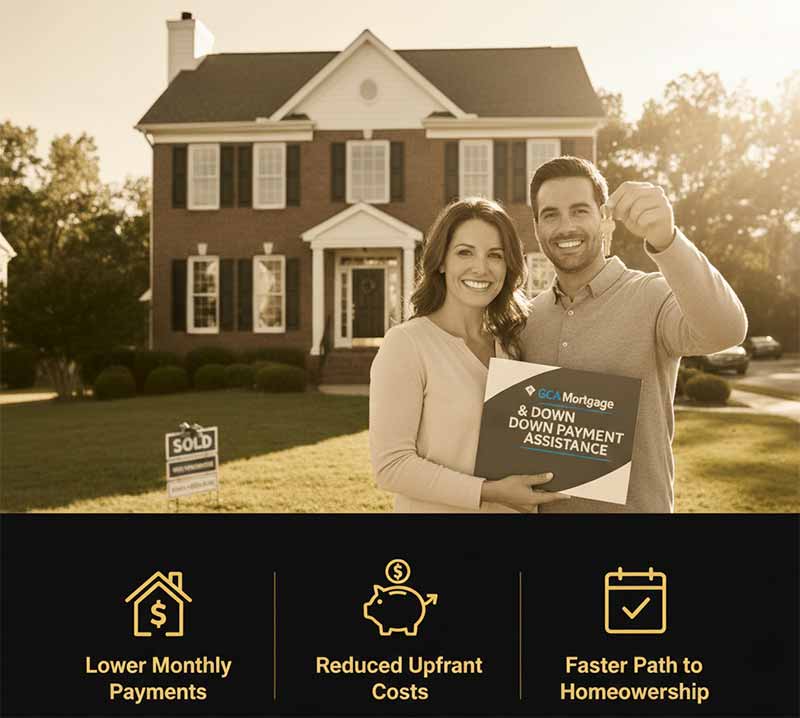
Virginia offers several assistance options. The two main providers are Virginia Housing and the Virginia Department of Housing and Community Development (DHCD).
Virginia Housing (Down payment Assistance Grants and Other Options)
- Virginia Housing provides a Down Payment Assistance Grant, along with other grant and loan programs.
- Your eligibility depends on the loan, your income, and the home’s location, including if it is in an “Area of Economic Opportunity.”
Virginia DHCD Homeownership’s Down Payment Assistance Program (Pilot)
- The Virginia DHCD offers a down payment assistance program for some first-time homebuyers.
- People who qualify may have incomes up to 60% of the Area Median Income (AMI), and the program may give up to $50,000, according to the DHCD website.
- Assistance program details may change and often include income and purchase price limits, preferred lender requirements, and mandatory counseling or education.
- It is recommended to select a mortgage program first, then pursue available assistance options.
- Home affordability changes with interest rates and the number of homes for sale.
- Recent reports often highlight Roanoke and parts of Southside and Southwest Virginia as some of the most affordable areas in the state.
- Cities often listed as more affordable include Roanoke, Danville, Martinsville, and Lynchburg.
- However, prices and availability can still vary by neighborhood.
A Commonly Mentioned Affordable County In Virginia:
Kiplinger, using Census data, lists Buchanan County as one of Virginia’s most affordable places, with home prices much lower than the state average. If you are considering a longer commute to a higher-paying job, remember to add up all the costs, including home price, taxes, insurance, and travel expenses.
Choosing the best mortgage program depends on who can qualify for it.
The most common types of mortgage loans in Virginia are:
- Conventional loans are available for borrowers with good credit.
- FHA loans for first-time homebuyers, with flexible credit rules; VA loans for qualifying service members and veterans (very common in Virginia); and USDA loans for approved rural and suburban areas (sometimes with 0% down).
- Jumbo loans for higher-priced markets, especially in Northern Virginia (NoVA).
- Non-QM loans for self-employed people and those who need different proof of income
Securing The Lowest Possible Interest Rate On A Virginia Home Loan
Mortgage rates can change very quickly, but you can still get a good deal on your Virginia home loan. Here are some tips to give yourself the best chance: pay down credit card balances, since credit utilization is important for your credit score.
- Avoid taking on new debt before closing on the property.
- Fix any mistakes on your credit report before you sign a contract to buy a home.
Finding The Right Loan For Your Profile
- FHA loans may be easier to qualify for, but have higher mortgage insurance costs.
- Conventional loans may be a better long-term option if you have a strong credit history.
- A VA loan is ideal for eligible borrowers, as it does not require monthly mortgage insurance.
Lower Your DTI
- To lower your debt compared to your income, focus on paying off debts with smaller monthly payments, such as installment loans.
- Keep in mind that even loans with the same interest rate can have very different closing costs.
Always Ask For A Detailed LIst Including:
- Origination/underwriting fees
- Discount points
- Any lender credits
- Title and escrow fees
Virginia Mortgage Loans: Lock Timing
In a changing market, locking in your rate at the right time and knowing your options to lower your rate later can help you save money on payments.
Why Choose GCA Mortgage Group For Virginia Mortgage Loans?
We help people across Virginia with all loan options, from FHA and VA to jumbo and Non-QM. If other lenders say no, we will help you work through extra rules, different income situations, or credit problems to find your best path to approval.
FAQs About Virginia Mortgage Loans
Affordability varies dramatically across Virginia. Generally, areas further from the D.C. and Richmond metro areas offer more reasonable home prices. Cities like Roanoke, Lynchburg, and Danville, as well as counties in Southside and Southwest Virginia, often provide a lower cost of living and more affordable housing options. For those who need to be near a major job center but want value, exploring counties on the periphery of Northern Virginia, like Fauquier or Culpeper, can be a good compromise. Below you will find a list of frequently asked questions on Virginia Mortgage Loans,
What Credit Score Is Required For A Mortgage Loan In Virginia?
- It depends on the loan type.
- FHA has more flexible credit than conventional loans, and jumbo loans have higher credit and reserve requirements.
Which Mortgage Is The Easiest To Qualify for In Virginia?
- FHA loans are often considered among the most accessible options due to flexible underwriting guidelines.
- For eligible applicants, VA loans also offer favorable terms and require no down payment.0% down.
Are There Any Virginia Mortgage Loan Options That Require A 0% Down Payment?
- Yes.
- Qualifying borrowers may also access USDA loans, which require no down payment but are subject to property location and income eligibility criteria.
How Can I Determine If A Home In Virginia Qualifies For USDA Financing?
- To determine if a property is located in a qualifying area, consult the USDA property eligibility map; final verification is completed by an underwriter.
What Down Payment Assistance Options Are Available In Virginia?
- Virginia Housing offers down payment assistance through its Down Payment Assistance Grant, which is available with certain Virginia Housing loans and meets other program eligibility requirements.
- The Virginia DHCD site also provides information about a DPA pilot program with associated income and assistance limits.
Does One Have To Be A First-Time Homebuyer To Qualify For Virginia Housing?
- Certain Virginia Housing programs require first-time homebuyer status.
- However, these restrictions may be waived for purchases in designated Areas of Economic Opportunity. Program rules vary.
How Do Jumbo Loans Differ From Conventional Loans In Virginia?
- Conventional loans are bound by conforming limits, whereas jumbo loans exceed these limits and typically require stronger credit, verified income, and cash reserves.
Is It Possible For Self-Employed Borrowers To Qualify For A Mortgage In Virginia Without Providing Tax Returns?
- Although traditional loans generally require tax returns,
- Non-QM programs may permit alternative documentation, such as bank statements, in accordance with specific program guidelines.
Which Places In Virginia Have The Lowest Average Home Prices?
- Affordability rankings frequently include Roanoke, Danville, and Buchanan County among the most cost-effective areas in Virginia.
What Can You Do To Lower Your Mortgage Payments In Virginia?
- Several strategies can help reduce mortgage payments, including improving credit scores, lowering the debt-to-income (DTI) ratio, increasing the down payment, selecting an appropriate loan type, and comparing lender fees and points.
What’s The Average Time To Get A Home Loan In Virginia?
- Timelines vary based on loan type, required documentation, and appraisal and underwriting guidelines.
- Completing pre-approval and assembling a comprehensive documentation package can expedite the process.
Getting The Approval Process On Your Virginia Mortgage Loans
Affordability varies dramatically across Virginia. Generally, areas further from the D.C. and Richmond metro areas offer more reasonable home prices. Cities like Roanoke, Lynchburg, and Danville, as well as counties in Southside and Southwest Virginia, often provide a lower cost of living and more affordable housing options.
For first-time homebuyers using a VA or USDA loan, the CCA Grant is a perfect match. It offers up to 2% of the purchase price to help cover closing costs, discount points, prepaid items, and even the VA funding fee or USDA guarantee fee.
This grant directly reduces your out-of-pocket expenses at closing, making the entire process more affordable. This program is a game-changer for buyers who lack down payment savings. The Plus Second Mortgage provides a second mortgage to cover the entire down payment. For borrowers with a credit score of 680 or higher, it can even cover closing costs. This 30-year fixed-rate loan is paired with a Virginia Housing first mortgage, allowing qualified buyers to purchase a home with zero down payment.
Looking to Refinance Your Virginia Home?
Apply online 24/7 with Gustan Cho Associates for a personalized Virginia mortgage review based on your current rate, equity, and long-term plans
