Non-QM Jumbo Mortgages For Non-Prime Borrowers

If you’ve been turned down by traditional lenders due to credit issues, high debt-to-income ratios, or self-employment income, but you still need financing for a high-priced home, Non-QM jumbo mortgages for non-prime borrowers may be the solution. These unique loan programs are designed for borrowers who don’t meet the strict guidelines of conventional loans but still want to purchase or refinance homes that exceed conforming loan limits. In this guide, we’ll cover everything you need to know about Non-QM jumbo mortgages for non-prime borrowers, including how they work, who qualifies, and how to get approved.
Traditional Versus Non-QM Jumbo Mortgages
Traditional jumbo loans are full-doc jumbo mortgages. Full documentation and income tax returns are required on traditional jumbo mortgages. Non-QM jumbo mortgages are nonconforming non-traditional high-balance home loans with alternative lending income and credit guidelines. There are different types of non-QM jumbo mortgages.
Need a Jumbo Loan But Don’t Fit the Box?
Non-QM jumbo mortgages are built for borrowers with unique income, credit, or documentation challenges.
Non-QM Jumbo Mortgage Guidelines
Each non-QM jumbo mortgage lender has its own lending requirements. Non-QM jumbo mortgages are portfolio loans. Portfolio loans are mortgage loans that are normally held by the lender in their books or sold to preferred private investors on the secondary market. Besides non-QM loans, Gustan Cho Associates offers traditional jumbo loans with a 10% down payment and credit scores down to 660 FICO. The debt-to-income ratio is capped at 50% on the 90% LTV jumbo loan programs.
How Much Down Payment Is Required on Non-QM Jumbo Mortgages
The down payment requirement on non-QM jumbo mortgages depends on each individual lender. The lower the borrower’s credit profile, the higher the risk for the lender, and the higher the down payment requirement. Borrowers with lower credit scores may require a 30% or more down payment. Other borrowers with higher credit scores may require a 10% to 20% down payment. The lower the loan to value, the lower the mortgage rates on non-QM jumbo mortgages. Higher credit scores yield lower rates and also hold true on traditional jumbo loans. The amount of down payment required depends on borrowers’ credit scores and other factors.
How Is Qualified Income Calculated on non-QM Jumbo Mortgages?
Lenders of Non-QM jumbo mortgages for self-employed borrowers without income tax returns calculate income on bank statement loans by averaging 12 months of bank statement deposits.
That monthly average is the borrower’s monthly income. Income tax returns are not required. Withdrawals do not matter and do not count.
Up to 50% debt-to-income ratios. Now self-employed borrowers who have a lot of write-offs on their tax returns can qualify for Non-QM jumbo mortgages with no tax returns. In this article, we will cover and discuss Non-QM Jumbo Mortgages For Self-Employed Borrowers.
Loan Limits On Home Loans
Conventional Loans and Government Loans have maximum loan limits. Any loan amount exceeding loan limits is called non-conforming loans or jumbo loans. For example, FHA standard loan limits are capped at $420,680 unless the property is located in a high-cost area. High-cost conforming and FHA loan limits on single-family homes are capped at $970,800 for 2022. For example, The higher FHA loan limits are set by HUD, the parent of FHA, in counties that are classified as high-cost areas.
Maximum Loan Limits on Traditional Conforming Loans
For conventional loans, the Federal Home Loan Mortgage Corporation, Freddie Mac, and the Federal National Mortgage Association regulate the home loan industry. FHFA, The Federal Housing Finance Agency, is the governmental agency that regulates Fannie Mae and Freddie Mac and sets conforming loan limits. Fannie Mae and Freddie Mac regulate conforming guidelines and set maximum lending limits.
Today, the maximum conventional loan limits vary depending on location and property type, but they are typically set by the Federal Housing Finance Agency (FHFA).
These boundaries may fluctuate each year in response to the conditions of the housing market. Standards set by Fannie Mae and Freddie Mac are secured by FHFA and are called conforming loans. Any mortgage loans that fall outside the conforming lending limits are classified as non-conforming loans or JUMBO MORTGAGES.
What Are Jumbo Mortgages?
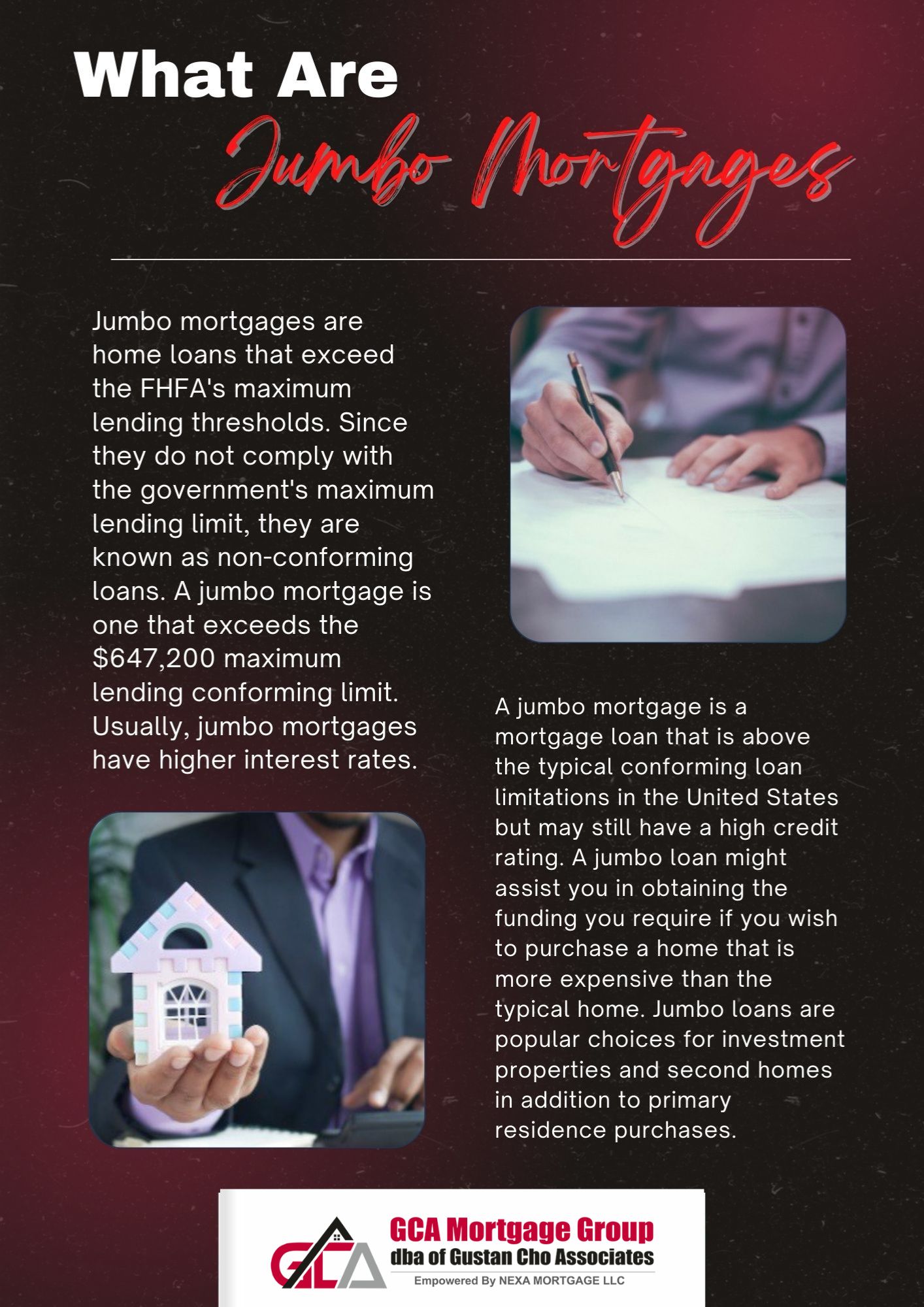
Jumbo Mortgages are residential mortgage loans that fall over the maximum lending limits set by FHFA. It is called non-conforming loans since it does not conform to the government’s maximum lending limit. Any mortgage loan over the maximum lending conforming limit of $647,200 is considered a Jumbo mortgage. Jumbo mortgages normally have higher interest rates.
What Are The Eligibility Requirements on Jumbo Mortgages Versus Traditional Loans
Qualifications are much tougher than conforming loans. Gustan Cho Associates now offers Jumbo Loans with a 10% down payment. The minimum credit score required is 660 FICO. The maximum debt-to-income ratio to qualify for a 90% LTV Jumbo Mortgage is 50%. This is a traditional jumbo loan program and NOT a non-QM loan product.
Credit Issues? You Can Still Get a Jumbo Loan
We specialize in non-QM jumbo loans for self-employed, non-prime, or recently recovered borrowers.
Is It Bad To Have The Most Expensive House In The Neighborhood?
To get approved for Jumbo mortgages, the home needs to appraise. The appraiser needs comparable sales of the higher-priced homes. Home Buyers can not have a white elephant where most of the homeowners in the neighborhood have standard conforming loans because it will be difficult to get comparable sales. If the house is the only high-end home that is larger and more expensive than the norm, it will be difficult for the appraiser to get comparable sales.
Down Payment and Credit Score Requirements on Traditional Jumbo Loans
Most folks who seek Jumbo mortgages need to put in a 20% down payment. Most jumbo lenders require credit scores of 700 or higher. Maximum debt to income ratios is capped at 50%. Jumbo borrowers who are seeking the best available interest rates need credit scores of 740 FICO or higher and a loan to value at 75%. Jumbo mortgage interest rates are normally 0.50% higher than regular conforming interest rates.
Non-QM Mortgages Versus Traditional Jumbo Lending Guidelines
Non-QM Mortgages have much more lenient lending guidelines than traditional jumbo loans. Jumbo Mortgages have tougher mortgage lending criteria than conventional mortgage loans. There is no waiting period after foreclosure, deed in lieu of foreclosure, or short sale to qualify for NON-QM Jumbo Mortgages.
Borrowers with 620 credit scores can qualify for Non-QM jumbo mortgages whereas traditional jumbo lenders want 700 credit scores.
10% to 20% down payment is required on jumbo Non-QM jumbo mortgages where most traditional jumbo lenders want a 10% to 25% down payment. There is no mortgage insurance required on jumbo Non-QM jumbo mortgages even with higher than 80% loan to value.
Non-QM Mortgage Rates Versus Traditional Rates
Interest rates on Non-QM Jumbo mortgages are slightly higher than traditional jumbo loans. Most Jumbo mortgage lenders require a minimum of 20% to 25% down payment on a home purchase. To get the best Jumbo mortgage interest rates, the Jumbo mortgage loan borrower should have at least a 740 credit score, have a 25% down payment, have no more than a 40% debt to income ratio, and have reserves on traditional jumbo loans. However, NON-QM Jumbo Mortgages with lower credit scores. 10% to 20% down payment. 50% debt to income ratio caps on Non-QM jumbo mortgages. The down payment requirements depend on the borrower’s credit scores.
Special NON-QM Jumbo Mortgages For Self-Employed Borrowers
We now offer a 10% down payment, and 90% loan to value, with no private mortgage insurance required for qualified borrowers. Non-QM Mortgages for self-employed borrowers is a special jumbo loan program where no tax returns are required. 12 months of bank statement deposits are averaged and the monthly deposits are used as monthly income. Borrowers can use personal and/or business bank statements. 100% of deposits can be used on personal bank statements. 50% of deposits are used on business bank statements. Needs to be from the same bank account and multiple bank statements are not allowed. Overdrafts are not allowed.
Minimum Credit Scores Down To 550 FICO On Non-QM Loans
To qualify, the Jumbo mortgage loan borrower needs to have a minimum credit score of 550. The borrower’s debt-to-income ratios cannot be greater than 50% DTI. Private mortgage insurance is not required on Non-QM jumbo mortgages with higher than 80% LTV. The Jumbo mortgage lender wants to see a strong credit borrower with ample reserves and assets.
Frequently Asked Questions About Non-QM Jumbo Mortgages for Non-Prime Borrowers
1. What is a Non-QM Jumbo Mortgage for Non-Prime Borrowers?
A Non-QM jumbo mortgage for non-prime borrowers is a home loan that does not meet standard mortgage guidelines (called Qualified Mortgage rules) and is used for high loan amounts—typically over the conforming loan limits. It is created for borrowers who may have credit issues, high debt-to-income (DTI) ratios, or unconventional income.
2. Who are Non-Prime Borrowers?
Non-prime borrowers are individuals who don’t meet traditional lending standards. This can include people with:
- Low credit scores
- Recent bankruptcies or foreclosures
- Self-employed income
- High DTI
- Limited documentation
3. How much can I borrow with a Non-QM Jumbo Mortgage?
Non-QM jumbo mortgage limits vary by lender but typically start at $726,200 and can go into the millions. These loans are ideal for high-cost housing markets or luxury home purchases.
4. Can I qualify for a Non-QM jumbo loan with bad credit?
Yes. One of the main benefits of Non-QM jumbo mortgages for non-prime borrowers is flexible credit guidelines. Many lenders accept credit scores as low as 500, depending on the down payment and overall loan profile.
5. Is there a minimum down payment for Non-QM jumbo mortgages?
Down payment requirements vary. Some Non-QM jumbo lenders allow down payments as low as 10%, while others may require 20% or more especially for borrowers with lower credit scores or recent credit issues.
6. Can I use bank statements to verify income for a Non-QM jumbo loan?
Yes. Many Non-QM jumbo mortgage lenders offer bank statement loans for self-employed borrowers who can’t document income through tax returns. They typically review 12–24 months of personal or business bank statements.
7. What interest rates are typical for Non-QM jumbo loans?
Non-QM jumbo mortgage rates are generally higher than traditional loans because of the increased risk. Rates depend on credit score, loan-to-value (LTV), documentation type, and property type.
8. Do Non-QM jumbo mortgages require mortgage insurance?
No. Even with less than 20% down, most Non-QM jumbo loans for non-prime borrowers do not require mortgage insurance (PMI), helping you save on monthly payments.
9. Can I use a Non-QM jumbo loan to buy an investment property?
Yes. Non-QM jumbo mortgages can be used for primary residences, second homes, or investment properties, including DSCR loans (Debt Service Coverage Ratio) for rental income qualification.
10. How is DTI calculated for Non-QM jumbo mortgage borrowers?
Lenders use different approaches for non-QM DTI calculations. Some allow higher ratios—up to 50% or even higher—especially for self-employed borrowers or those using asset-based income.
Gustan Cho Associates now offers Non-QM jumbo mortgages for non-prime and self-employed borrowers with credit scores as low as 550 FICO. No income tax returns are required for self-employed borrowers. We can use 12 months’ bank statement deposits to calculate qualified income. A 20% to 30% down payment on a home purchase is required on non-QM and alternative financing loan programs.
Non-QM Jumbo Loans for Real-World Borrowers
No W-2s? Bank statement income? Recent credit events? We’ve got you covered with flexible jumbo loan options.