

Massachusetts Mortgage Loans
Massachusetts Mortgage Loan Guide for 2026
Find all the details on Massachusetts mortgage loans, including FHA, VA, USDA, conventional, non-QM, and jumbo options. Learn about first-time buyer programs, down payment help, top rates, and the most affordable cities to buy a home.
Massachusetts offers many mortgage programs to help people become homeowners. Whether you are buying your first home or have served in the military, there is support to help you buy a home, regardless of your financial situation.
The Massachusetts housing market has both challenges and opportunities. Choosing the right mortgage for your finances is important. This guide will help you through each step, from looking at your options to closing on your new home. Compare Massachusetts mortgage loans—from FHA, VA, and USDA programs to conventional, non‑QM, and jumbo Massachusetts mortgage loans—plus down payment assistance, first‑time buyer programs, and how to get the best home‑loan rate in Massachusetts. Learn what type of Massachusetts mortgage loan is easiest to qualify for and which Massachusetts cities and counties offer the most reasonable housing options for homebuyers.
Overview of Massachusetts Mortgage Loans
In Massachusetts, you can pick from different loan types depending on your credit, down payment, income, and other details. Your location—city, suburb, or rural area—also affects which loans are available to you.
Most people in Massachusetts get home loans through federal and state programs. The most common are FHA, VA, USDA, and conventional loans. State agencies can also help make buying a home more affordable.
Combining these programs can help you save money and buy a better home. Mortgage applications are rising in Massachusetts. Most buyers pick conventional loans, while first-time buyers often choose FHA loans. As job growth continues, more people want to buy homes, but finding affordable options remains difficult.
FHA Loans in Massachusetts
FHA loans help Massachusetts homebuyers, especially those with limited savings. If your credit score is 580 or higher, you can buy a home with just 3.5% down, which is much less than the 5% to 20% usually needed for other loans. Even if your score is between 500 and 579, you can still qualify if you put 10% down. This flexibility is very helpful in a state where home prices are higher than the national average.
In most Massachusetts counties, the FHA lending limit for single-family homes is $541,287. However, in Suffolk, Norfolk, Middlesex, Essex, and Plymouth counties, the limit is $1,249,125, which allows FHA borrowers in these areas to buy more expensive homes.
FHA loans often have lower interest rates than conventional loans. Borrowers pay a one-time mortgage insurance fee of 1.75% and an annual fee between 0.45% and 1.05%. Even with these costs, FHA loans are often the most affordable choice for buyers with little savings or lower credit scores. FHA loans allow debt-to-income ratios up to 50%, which helps in Massachusetts, where homes are expensive. You can also use gift money for the full down payment and closing costs, making it easier for families to help.
Massachusetts Mortgage Loans—Get Pre-Approved With Confidence
Apply For A Loan That Fits Your Goals
VA Massachusetts Mortgage Loans For Active and Retired Service Members
VA loans give Massachusetts veterans, active-duty service members, and eligible surviving spouses valuable benefits. There is no down payment, no monthly mortgage insurance, and some of the lowest interest rates, which can save you money over time.
About 360,000 veterans in Massachusetts qualify for VA loans. The zero-down option is especially helpful in expensive markets, where saving $120,000 for a 20% down payment on a $600,000 home could take years.
VA loans no longer limit how much eligible borrowers can finance with no money down. However, for borrowers who do not have full entitlement, loans over the conforming loan limit of $806,500 in most counties in Massachusetts ($1,209,750 in higher-cost counties) may require a down payment on the amount over these limits. This change, made in 2020, allows veterans to obtain a loan for a higher-priced property.
Eligibility Requirements On VA Massachusetts Mortgage Loans
The VA funding fee, ranging from 1.4% to 3.6%, may be included in the loan amount rather than paid up front. Veterans with service-connected disabilities are exempt from this fee. Because there is no monthly mortgage insurance, monthly payments are often lower than those for FHA or conventional loans with small down payment.
In Massachusetts VA loan programs requires a Certificate of Eligibility that satisfies all program service requirements. Additionally, properties must meet the VA’s minimum standards for safety, soundness, and sanitation to protect both the borrower and the VA’s interest.
VA appraisers conduct comprehensive property reviews and may identify issues that must be resolved before closing. Although these requirements may appear extensive, they enable veterans to purchase homes in need of repair.
USDA Loans in Massachusetts: Rural Housing Financing with No Money Down
United USDA loans let you buy a home with no money down in rural parts of Massachusetts, and some suburban areas also qualify. Whether you can get this loan depends on the home’s location and your household income. Many towns in Worcester, Hampshire, Franklin, and Berkshire counties, as well as parts of Plymouth, Bristol, and Barnstable, are included.
The income limit on USDA Massachusetts Mortgage Loans is usually about 115% of the area’s average income. In Massachusetts, a family of four may qualify with incomes from $103,000 to $130,000, depending on the area.
The USDA Rural Development income limits make USDA loans available to many middle-income families. There is a 1% closing fee and a 0.35% annual fee, but these costs are often offset by lower rates, sometimes even better than conventional loans. Many buyers can roll closing costs into the loan, so they can move in with little or no out-of-pocket costs. The USDA program in Massachusetts includes two loan types: the Guaranteed Loan Program, offered through approved lenders for most borrowers, and the Direct Loan Program, which provides subsidized loans directly from USDA to very low- and low-income applicants. The Direct Loan Program can offer payment help to households earning up to 80% of the area median income, possibly lowering the interest rate to as low as 1% for those with the greatest need. However, direct loans usually take longer to process than guaranteed loans.
Conventional Loans in Massachusetts: Flexible Financing for Qualified Borrowers
Conventional loans are the most popular choice for Massachusetts buyers and are not backed by the government. They work best for people with good credit and a steady income. You need a credit score of at least 620, but 680 or higher gets you the best rates. First-time buyers can start with as little as 3% down, or even 0% with special programs like HomeReady and Home Possible. Most loans need 5% down, and larger or multi-unit properties may need 10% to 20%.
In 2026, most Massachusetts counties will have a single-family conventional loan limit of $832,750. High-cost counties, including Suffolk, Norfolk, Middlesex, Essex, and Plymouth, have a limit of $1,249,125.
These match FHA high-balance limits, but conventional loans are often more attractive if you qualify. If you put down less than 20% on a conventional loan, you will need private mortgage insurance (PMI), which usually costs 0.3% to 1.5% of your loan amount each year. The good news is that, unlike FHA insurance, you can cancel PMI once you have enough equity in your home. This helps Massachusetts buyers save money over time.
Fannie Mae And Freddie Mac Guidelines On Property Eligibility
Conventional loans are flexible and can be used for your main home, a vacation home, or an investment property. If your loan amount is within the set limits, you can borrow more without the extra steps required for jumbo loans. This makes it easier to buy homes at different prices in Massachusetts. You can get conventional mortgages in Massachusetts from national and local banks, credit unions, and mortgage companies. Interest rates can vary by 0.25% to 0.5% or more between lenders, and over 30 years, this can add up to a significant amount. The best loan terms usually go to people with good credit, steady jobs and income, and low debt compared to their income.
Non-QM Loans in Massachusetts: Financing Options for Non-Traditional Borrowers
Non-QM loans in Massachusetts are for people who do not meet the usual loan requirements. If you are self-employed, an investor, have had recent credit problems, or your income changes, these loans can help you buy a home. Many people in Massachusetts are self-employed, such as small business owners, freelancers, and independent contractors.
Traditional mortgages can be hard to get if your tax returns do not show all your income. Non-QM bank statement programs let you qualify based on your actual bank deposits, giving self-employed buyers a better chance to buy a home.
Asset-depletion loans are another Non-QM option for Massachusetts borrowers with substantial assets but little or no income, such as retirees or people with trust funds. These programs calculate a monthly income by dividing your assets over a set number of years and use that number to decide if you qualify for a mortgage. For example, $3 million in assets can count as a monthly income of $35,000 to $50,000, even if your tax returns show low income. If you have had a recent foreclosure, short sale, or bankruptcy, you usually have to wait 3 to 7 years before you can qualify for a regular loan.
The Benefit Of Non-QM Mortgage Loans In Massachusetts
Non-QM loans can help much sooner, sometimes just a day after your case is closed, but you will pay higher rates and need a bigger down payment. These loans also help buyers who want interest-only payments, buyers of condos that do not meet standard rules, and investors who qualify based on rental income rather than their own income.Non-QM loans usually have interest rates 1.5% to 3.5% higher than regular loans because they are riskier for lenders. Down payments are usually 10% to 20%, but can be 25% or more if you have poor credit or not much paperwork. Even with higher costs, these loans are very helpful for buyers who do not meet the usual requirements.
Jumbo Massachusetts Mortgage Loans
Jumbo mortgages help buyers get loans for homes that cost more than the usual limits, especially in expensive areas like Greater Boston, Cape Cod, Martha’s Vineyard, and Nantucket. These loans have stricter rules but can offer good rates to the best borrowers. In many Greater Boston towns, million-dollar homes are common, and loans of $1.5 million to $3 million are normal.
Lenders often want credit scores above 740 and may require down payments of 25% to 30% for the largest loans. Debt limits are usually set at 43% to 45%, but some programs go up to 50% if you have a lot of savings. You will also need substantial cash reserves on Jumbo loans.
Jumbo loans require you to have more money saved than regular loans. Instead of 2 to 6 months, you might need 6 to 12 months of payments saved up. For a $2 million loan with a $12,000 monthly payment, you will need $72,000 to $144,000 in the bank, plus your down payment and closing costs.
Jumbo loan rates are now much closer to regular loan rates. In Massachusetts, buyers with excellent credit, large down payments, and high incomes can often get jumbo rates that are only 0.125% to 0.25% higher than regular loan rates, or even lower. You can get jumbo loans in Massachusetts from national banks, local banks, and credit unions. Since rates and terms can vary a lot, it is important to compare lenders. If you are borrowing $2 million or more, look for lenders who specialize in super-jumbo loans to get the best deal.
assachusetts Home Loans When Credit Needs Work
Late payments, collections, or higher debt-to-income doesn’t always mean “no.” Get a fast review and the best loan path based on real guidelines—not guesswork
First-Time Homebuyer Massachusetts Mortgage Loans
Homebuyers in Massachusetts can also use several programs to make buying a home more affordable. Qualified buyers may get help from the Massachusetts Housing Partnership (MassHousing) and city programs that offer down payment help, lower interest rates, and educational resources.
MassHousing offers first-time buyer programs with conventional, FHA, and VA loans, often at below-market interest rates. First-time buyers are those who have not bought a home in the past three years, which expands the pool of those who can qualify.
Most MassHousing loans do not have income limits, though some area-specific programs might. This assistance is set up as a deferred, interest-free payment, which can greatly reduce upfront costs.
The ONE Mortgage Program In Massachusetts
The ONE Mortgage Program offers 30-year fixed-rate loans with just 3% down, plus down payment assistance. MassHousing works with VA, FHA, and conventional lenders, and income limits only apply in certain areas. Many local programs supplement the state programs. The ONE+ Mortgage Program in the City of Boston offers
Local programs open new doors for homebuyers. In Boston, the ONE+ Mortgage Program gives first-time buyers a boost with up to $50,000 for a down payment.
To qualify, you need to complete a homebuyer education course and meet income guidelines based on your family size. Across Massachusetts, a variety of programs offer their own unique benefits and requirements, giving buyers plenty of options to explore. Most assistance programs start with a homebuyer education course, your roadmap to understanding the journey ahead. These classes walk you through everything from choosing a mortgage to budgeting for your new home, and what it really means to be a homeowner. For a modest fee of $50 to $100 and a commitment of 6 to 8 hours—online or in person—you’ll earn a certificate that opens the door to MassHousing programs, city assistance, and special lender perks.
The First-Time Hombuyer Tax Credit In Massachusetts
People looking to buy a home in Massachusetts should keep an eye on changes in federal laws. The First-Time Homebuyer Tax Credit, which used to offer tax breaks to first-time buyers, is not available right now but could return. In the past, tax credits of $5,000 to $15,000 made buying a home more affordable and were backed by the government to help more people own homes. These credits lower the amount of taxes you owe, which helps reduce the total cost of buying a home.
Federal Housing Administration (FHA) loans help buyers with limited credit history or savings get a mortgage. FHA home loans are easier to qualify for, offer more flexibility with your debts and income, accept credit scores as low as 580, and require only a 3.5% down payment.
Veterans and service members who qualify can get VA loans, which are easy to get, do not require a down payment, and do not have a set minimum credit score, though some lenders may ask for a score between 580 and 620. VA loans also have income limits. USDA loans help people in rural parts of Massachusetts buy homes. These loans do not need a down payment, are flexible with debts and income, and require a credit score of at least 640. Applicants must have steady jobs and meet income limits. These programs have good interest rates and help keep monthly payments affordable. MassHousing lenders use flexible rules to help more people qualify while still being careful with risk.
Non-QM Massachusetts Mortgage Loans
Non-Qualified Mortgage (Non-QM) loans open the door for self-employed buyers, those rebuilding after bankruptcy, or anyone with a nontraditional income. While these loans often come with higher costs, they offer flexibility by letting you prove your income with bank statements, fleet records, or rental receipts instead of tax returns. Some programs accept credit scores as low as 500, and putting more money down can help offset a lower score.
How To Boost Your Credit To Get Approved For Massachusetts Mortgage Loans
If you want to boost your chances of loan approval, start by trimming down debts like credit cards, student loans, or car payments. This not only helps your debt-to-income ratio but also improves your credit. Saving more money gives you a safety net and makes you look better to lenders. Checking with several lenders can help you find more flexible choices.
Affordable Cities And Counties In Massachusetts
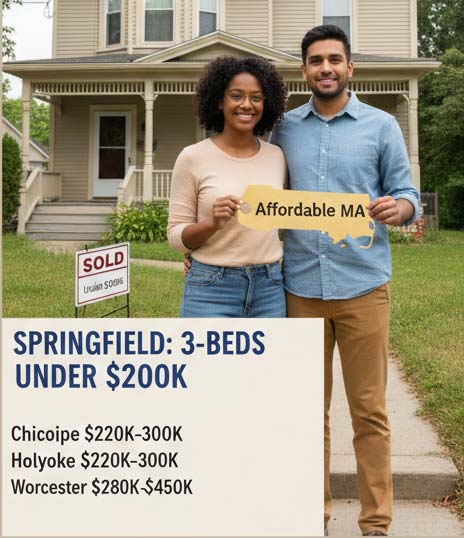
To save money, look for homes in Boston’s most affordable neighborhoods and set a budget you can stick to so you do not need a jumbo loan, which costs more. Ringfield, Chicopee, Holyoke, and Westfield. In Springfield, you can find a three-bedroom house for under $200,000 in many neighborhoods. The city also boasts affordable city living, vibrant cultural spots, and a wider selection of homes than Greater Boston.
Across these cities, median home values range from $200,000 to $320,000, making homeownership more accessible.
Springfield and nearby towns in Hampden County have some of the best home prices, with homes in Chicopee and Holyoke costing between $220,000 and $300,000. These prices are good for people willing to move outside Springfield, and the towns nearby also have great deals.
If you are open to living outside the busy I-495 area, these towns offer not just cheaper homes but also lower living costs, thanks to lower property taxes and insurance. This makes it easier to afford a home. These areas are also more affordable and have reasonable commutes to Boston. In Worcester, you can find three-bedroom homes for $280,000 to $450,000, with many under $350,000.
Higher Priced Homes In Massachusetts
While Cape Cod and South Shore towns often come with higher price tags, Fall River and New Bedford offer the charm of coastal living with median home prices between $350,000 and $420,000. These cities blend revitalized downtowns, diverse neighborhoods, and historic homes, making them attractive and attainable for middle-class families.
Three-bedroom homes in sought-after areas can be found for $300,000 to $400,000, and emerging neighborhoods offer even more bargains. Some Barnstable County towns on Cape Cod are more budget-friendly than hotspots like Chatham or Provincetown.
Year-round buyers will find Hyannis, Yarmouth, and Dennis more affordable, with homes from $400,000 to $550,000. Just remember to factor in flood insurance, which can add $1,000 to $4,000 or more to your annual costs.
Affordable Rural Areas In Massachusetts
Western Massachusetts is the most rural and affordable part of the state. Towns in Franklin County, such as Greenfield, Orange, and Athol, have average home prices ranging from $240,000 to $350,000. There may be fewer jobs, but these places are great for people who work from home, retirees, or anyone who wants to save money by avoiding a short commute. Some areas with higher home prices might be a better deal in the long run because taxes are lower. Buyers should consider the total monthly cost, including the loan, interest, property taxes, insurance, and homeowners’ association fees, when deciding what they can afford.
Massachusetts Down Payment Assistance Programs
Massachusetts Down Payment Assistance Programs address the biggest obstacle for many buyers: covering the down payment and closing costs. Depending on your location, state, city, and nonprofit programs, you can receive anywhere from $5,000 to $50,000 to help you get the keys to your new home.
First-time buyers working with a MassHousing lender can unlock $30,000 in down payment help through the MassHousing Down Payment Assistance Program.
This assistance comes as a deferred payment loan, meaning you pay nothing each month and only repay when you sell, refinance, or transfer your home. As long as you own the property, the loan stays interest-free. You can pair this program with most MassHousing mortgages, including the ONE Mortgage and conventional loans. MHP offers a range of assistance programs tailored to different groups and communities. Through the ONE Mortgage program, buyers can access down payment grants and deferred loans, with up to $50,000 available in select cities. The amount and requirements depend on where you buy, with Boston, Worcester, and Springfield providing the most generous support.
How Do You Qualify For Housing Assistance Programs In Massachusetts
To qualify, your income must fall below a set limit for your family size, you’ll need to complete a homebuyer education course, and the home must be under the area’s price cap. This assistance acts as a second mortgage with no monthly payments, repaid only when you sell or refinance. Similar programs are available in Cambridge ($45,00). The Equity Builder Program from the Federal Home Loan Bank of Boston awards grants of up to $22,000. To qualify, you’ll need to meet income guidelines and attend homebuyer seminars. Use the grant for your down payment or closing costs, and if you stay in your home for five years, you never have to pay it back. This program works with FHA, conventional, USDA, or VA loans. Conventional, USDA, or VA loans.
The Teacher Next Door Grant In Massachusetts
Some assistance programs are crafted for specific professions in high-need areas. The Teacher Next Door grant, for instance, helps teachers with down payments in select Massachusetts communities. Similar grants support police officers, firefighters, and public health workers, helping them put down roots locally.
Veterans can also benefit from grants—often $5,000 to $15,000—that can be combined with VA loans to cover closing costs or home improvements. These programs often have more flexible income requirements and help communities keep essential workers close to home.
Most down payment assistance programs have similar rules. You must complete a homebuyer education course, stay under certain income limits, and not have owned a home in the past three years. There are also limits on the home’s price. Many programs require you to live in the home for 3 to 10 years, and if you sell early, you may need to repay some of the assistance.
How To Get The Best Rates On Massachusetts Mortgage Loans
The best rate on a Massachusetts home loan, start early, shop around, and don’t be afraid to negotiate. Even a tiny difference in your rate can save you thousands—sometimes $5,000 to $50,000 over the life of your mortgage. For instance, shaving just 0.25% off a 30-year loan could put $5,000 back in your pocket. a 30-year loan can save you. Raising your credit score is the single most powerful way to lower your mortgage rate. Mortgage rates can differ widely from one lender to another, even for the same borrower.
In Massachusetts, it pays to collect written quotes from four to six lenders—banks, credit unions, and brokers alike. Be sure you’re comparing apples to apples: same loan amount, down payment, lock period, and closing date.
Focus on the APR, not just the interest rate, since it includes all fees. And always request a detailed loan estimate to spot any hidden costs.
Lenders sort rates by score ranges—like 620-639, 640-659, and so on. For example, bumping your score from 695 to 720 could drop your rate by 0.25% to 0.375%, saving you $25,000 to $40,000 on a $500,000 loan over 30 years. To give your score a lift, pay down credit cards below 30% of your limit (or even better, under 10%), become an authorized user on a strong account, dispute any credit report errors, and hold off on new credit applications for six months before you apply for a mortgage.
Denied a Mortgage in Massachusetts? Get a Second Opinion
Many denials come from lender overlays—not the actual guidelines. We’ll review your scenario and show realistic options and next steps to approval
