

Nebraska Mortgage Loans
Nebraska Mortgage Loans: FHA, VA, USDA, Conventional, Jumbo, and Non-M Home Loans
Building a roadmap to homeownership in Nebraska starts with identifying financing options. Are you a first-time homebuyer? Maybe you are a veteran or even looking to enjoy an upgrade. This guide will help you pinpoint Nebraska mortgage loans, home state assistance mortgage programs, plus tips to help you get the best rates and terms on your home financing in the Cornhusker State.
Homes in Nebraska usually cost less than in many other states. The right mortgage depends on your credit, income, down payment, and where you want to live. This guide explains top loan programs, down payment help, first-time buyer tips, and how to get a good rate.
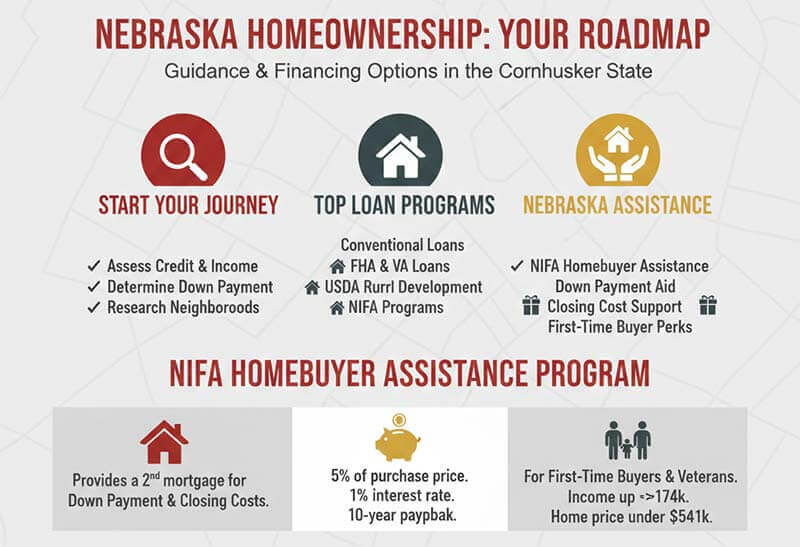
From government-backed mortgage loans with low calibrations to adjustable flexible options, Nebraska mortgage loans offer a plethora of adaptable financing to help complement your mortgage loan needs. Programs aimed at homeownership are fortified in the state’s housing market. Nebraska’s Investment Finance Authority (NIFA) is the state’s leading provider of mortgage loans and associated resources to adult Nebraskans, including down payment and closing cost assistance through the Homebuyer Assistance Program (HBA).
After Reviewing Nebraska’s Mortgage Options, Choose The Program That Best Fits Your Financial Goals
In Nebraska, the most commonly used loan types are Conventional, FHA, USDA, and VA. Each of these loans has specific target audiences and credit score requirements, making each more or less popular than the others. For example, USDA loans are more popular among buyers located in rural areas, FHA loans are more popular among first-time buyers, and VA loans are more popular among veterans.
The main provider of down payment assistance in Nebraska is NIFA. They offer first-time home buyers, as well as veterans and buyers in target areas, a second mortgage that covers the down payment and closing costs.
This mortgage is offered at a lower interest rate. Also, NIFA offers a $5,000 grant to qualified buyers. Choosing the right loan is the cornerstone of a successful home purchase. Below, we outline the types of mortgages Nebraska homebuyers have access to, the features that stand out, the benefits they offer, and the eligibility requirements. Discover Nebraska mortgage loans, including FHA, VA, USDA, Conventional, Non-QM, and Jumbo loans. Nebraska first-time homebuyer programs, down payment assistance, budget-friendly cities, and tips to get the best rates on home loans are included in this comprehensive guide.
Nebraska Mortgage Loans—Get Pre-Approved Fast
Buying or refinancing in Nebraska? Compare FHA, VA, USDA, Conventional, Jumbo, and Non-QM options and get a clear approval plan based on your credit, income, and down payment
Buying A Home Can Feel Overwhelming For Many Reasons:
Your location affects which loans you qualify for. For example, USDA loans can only be used for houses in certain rural jurisdictions, which makes the countryside and small towns good options for this type of financing.. On the other hand, if you have your heart set on buying a downtown Omaha condo, you won’t be eligible for a USDA loan.
- FHA loans: Many first-time homebuyers choose these because they are easier to qualify for and require a smaller down payment than regular loans.
- USDA loans: No down payment is needed, but you must buy in an approved rural or suburban area.
- USDA loans also have rules about your income and the home’s location.
- VA loans: No down payment required for qualified veterans or service members.
- Unlike FHA or conventional loans, VA loans do not require monthly mortgage insurance.
- Conventional Loans: You need a higher credit score and steady income, but you might get a better rate if you qualify.
- The down payment amount varies.
- Jumbo Loans: These are for loan amounts above the usual limit.
- You need better credit, a larger down payment, and more paperwork than with a regular loan.
- Non-QM Loans: Non-QM loans are for people who do not meet the usual rules for FHA, VA, or conventional loans.
- Non-QM loans are often used by self-employed people, investors, or those with recent credit problems.
Some areas in Nebraska are cheaper for home buyers than others. Finding these areas can save you a significant amount of money and reduce the size of your expected loan.
What Homebuyers You Should Know Before Applying For Nebraska Mortgage Loans
Take these steps to prepare for homeownership in Nebraska.
- Aim to get pre-approved rather than just pre-qualified.
- Pre-approval gives you an advantage over other buyers.
- Pick the mortgage type that matches your credit score and the amount you can pay up front.
- Check USDA/NIFA income limits and FHA and conventional loan amount limits.
- Fannie Mae and Freddie Mac’s conforming loan limits are updated every year.
- For 2026, the baseline for a single-unit conforming loan is $832,750. In high-cost areas, the limit is $1,249,125, with limits varying by county.
FHA loan limits also vary by county. For a quick way to find the FHA limits for your county, try GCA Mortgage Group FHA limits lookup.
Steps to Make Approval Easier For First-Time Homebuyers In Nebraska
If you’re buying your first home, focus on what lenders care about most. A steady job, consistent self-employment, and stable income over the past year are important.
- Keep your bank records simple and clear.
- Your statements should clearly show your finances.
- Try not to take on extra car loans, student loans, or credit card debt.
- New buyer assistance programs aim to help buyers enter the housing market.
- These programs are designed to reduce the costs of buying a home.
NIFA Homebuyer Assistance Program (HBA)
Use this guide to learn about Nebraska’s home loan options. You’ll find tips for first-time buyers, information on affordability in different cities, and advice for getting the best rates. We cover FHA, VA, USDA, Conventional, Jumbo, and Non-QM loans to help you choose what works for you.
The Homebuyer Assistance Program (HBA) from Nebraska Investment Finance Authority is designed to assist first-time home buyers, veterans, or home buyers in specified areas.
The Homebuyer Assistance Program provides buyers with second mortgages to cover the down payment and closing costs, which are 5% of the home’s purchase price. This second mortgage offers a low 1% interest rate and a 10-year payback period, making it easily repayable. Additionally, household income must be around $174,000 or less, and the home price must be under $541,287 for single-unit dwellings.
NIFA First Home Grant
NIFA also provides a $5,000 grant to qualifying applicants of the first mortgage of HBA, in addition to the HBA loans. This grant is also considered a gift and is deducted from the cash required for the down payment, making the home purchase more affordable.
The primary statewide agency for first-time homebuyers in Nebraska is NIFA (Nebraska Investment Finance Authority). NIFA offers first mortgage products and down payment and closing cost assistance.
Financial literacy is essential for all home assistance programs. NIFA participants eligible for HBA or First Home programs must complete an approved homebuyer education class prior to loan closing. This education equips participants to take on all the responsibilities that come with home ownership.
Ready to Buy a Home in Nebraska? Let’s Build Your Approval Plan
Upload docs or share your scenario and timeline. We’ll estimate closing costs, confirm the best program, and map your path to closing
Nebraska Housing Assistance Through NIFA And Down Payment Help
Many Nebraska homebuyers need help with upfront costs, and NIFA has several programs to assist. If you do not need help with your down payment or closing costs, you can move faster with lenders who offer these programs.
Welcome Home Program (NIFA)
NIFA also offers Welcome Home Assistance for first-time and repeat buyers who need help with down payments and closing costs. Income and purchase price restrictions apply. Every assistance program has its own rules, depending on funding and availability. NIFA’s Homebuyer Assistance Program helps buyers with down payments and closing costs.
For lenders and real estate agents, NIFA offers this as a first- and second-loan option. The second loan is 5% of the purchase price, lasts 10 years, and has an interest rate of 1%. There are more rules for the program.
Work with a lender who offers these programs and check the income and price limits before you start house hunting. Choosing the right loan for your finances can make approval easier, especially for first-time buyers. Often, the easiest to obtain is because of flexible credit requirements, especially for those with steady income and good financial management.
USDA Nebraska Mortgage Loans May Be Easiest For Those Who Qualify
USDA loans let you buy with no down payment, but you must meet rules about the home’s location and your income. Always check if the home qualifies using the official USDA map.
VA Loans Are Easiest For Veteran/Service Member Applicants
VA loans may not need a down payment and have flexible rules, but you must meet VA requirements.
FHA Nebraska Mortgage Loans
First-time homebuyers and people with poor credit often choose FHA loans, which are backed by the Federal Housing Administration. Nebraska offers loans for qualified borrowers with a down payment of only 3.5 percent of the purchase price and a credit score of 580 or higher. Mortgage insurance premiums (MIP) must be paid by borrowers and typically remain for the life of the loan, unless the borrower refinances.
Why Is FHA Popular In Nebraska
- Borrowers can put down less money than with other loans. An FHA loan is more forgiving than other loans.
- Helps with budgeting since loans have a fixed rate.
FHA loan limits vary by county. Use HUD’s FHA loan limits calculator to check your county’s limit.
VA Mortgage Loans In Nebraska
Nebraska Veterans and VA Loans
For veterans, active-duty service members, and some military spouses, there is a wonderful program called VA loans. VA Nebraska mortgage loans are backed by the U.S. Department of Veterans Affairs. With these loans, you have no down payment requirement and no monthly mortgage insurance. Therefore, you are able to finance 100 percent of your home’s value, which makes these loans very affordable.
VA loans are specialty loans designed for:
- Veterans
- Soldiers in active service
- Some surviving spouses
Key VA Advantages
- Often, VA loans require no down payment.
- No mortgage insurance is required for qualified borrowers.
USDA Nebraska Mortgage Loans
(Eligibility and lender underwriting apply; pre-approval is essential.) loans in Nebraska (Rural Development)
For buyers who want:
- No down payment
- A house in a qualified area
- Income under the program cap
In line with its name, the USDA Loan Program provides people the opportunity to purchase a home, specifically in rural and some suburban areas. Not only can people purchase a home, but they can also do so without a down payment, meeting the zero-down-payment requirement. Within the rural designated areas, people must also meet the income restrictions to qualify for the payment assistance. This will allow a lower mortgage payment for a short time. After assistance, the interest rate can be reduced to an astonishingly low level.
USDA loans can be a good option.
Verify Property Eligibility Of USDA Nebraska Mortgage Loans
Always use the USDA website to confirm property eligibility. Nebraska
Fannie Mae and Freddie Mac conventional loans are best for people with steady income.
- Some funds for the down payment (eligible Available funds for a down payment; some conventional options are available for eligible first-time buyers). Conforming loan limits for single-unit properties are $832,750 across all counties, though some counties have variations. To check your conforming loan limits, consult the FHFA county map.
Jumbo Nebraska Mortgage Loans
A jumbo loan exceeds the usual limit for your county. You will need a higher credit score for these loans. For buyers looking to purchase high-end houses, jumbo loans are required. These houses are priced beyond the conforming loan limits set by Fannie Mae and Freddie Mac. In luxury housing markets like Omaha or Lincoln, these non-conforming loans are the best options. Because these loans lack government backing, they tend to be pricier. Buyers will need to make a bigger down payment and stronger financial reserves to qualify.
- You may need more savings for these loans.
- For more expensive homes in or near cities, check your county’s loan limit to see if your home needs a jumbo loan.
- Check the minimum limit to know your loan type.
Non-QM Nebraska Mortgage Loans
People who do not meet the usual requirements for FHA, VA, or conventional loans can consider Non-QM (Non-Qualified Mortgage) loans. These are often used by self-employed people.
- Asset depletion (good for borrowers with a lot of assets)
- Loans for those with a recent credit event (varies by lender, on a case-by-case basis)
Non-QM loans can be helpful in special situations, but they often carry higher rates and require larger down payments. It is important to find the right lender. North Platte is known for being affordable, and many Nebraska cities have homes within reach.
Think about what you can afford by considering these factors in your area.
- Consider the cost of home insurance, property taxes, and the size of the local housing market when planning your move.
Conventional Loans In Nebraska
Conventional Loans cover a wide range of buyers and offer consumers flexibility. Unique to USDA Loans, Conventional Loans can require a down payment. For the Conventional 97 Program, a down payment of only 3% is required. To avoid the Private Mortgage Insurance requirements, a 20% down payment is needed. With Conventional Loans, cross that threshold and the borrower can cancel Private Mortgage Insurance.
Nebraska Home Loans With The Most Demand
The most popular home loans can change with market trends, but usually include these types.
- * Conventional *: The most popular home loans may change with market trends, but typically include the following types:
- * FHA (Administration) *: Typical for a first-time home buyer and/or a buyer with a lower credit rating.
- * VA (Veteran Administration) *: Typical for a military veteran.
- * USDA (United * USDA (United States Department of Agriculture) *: Common in many Nebraska areas for zero-down purchases, but the property must be in a USDA-approved location.
The Most Affordable Cities and Counties
The state’s affordability is often attributed to areas outside the two major metropolitan areas of Omaha and Lincoln. Most of the time, these areas provide the largest median home value decreases. Areas such as Grand Island, Kearney, and Bellevue provide affordable housing options and high levels of community services. For people wanting more wide-open spaces, the central and western Nebraska counties offer the most affordable options. When combined with the availability of USDA or VA no-down-payment loans, these areas provide home buyers with incredible value.
Denied by a Lender? Get a Second Opinion in Nebraska
Some lenders add overlays. We’ll review your scenario and show options that may work now—plus a step-by-step plan if you need a little time
How To Get The Best Interest Rate On Nebraska Mortgage Loans
Getting a lower interest rate can save you thousands of dollars. Here are some tips to get the best possible interest rate.
Raise Your Credit Score
Your credit score is a major factor in determining your interest rate. FHA loans can be obtained with a score of 580, but if you want to qualify for better rates on other loans, including conventional loans, your score will need to be higher. Before you apply, try to increase your score by paying your bills on time, paying down your credit card debt, and avoiding new debt.
Save for a Bigger Down Payment
Making a larger down payment helps to reduce the lender’s risk and, in turn, can secure a lower interest rate. Private mortgage insurance can be avoided on conventional loans once the 20% equity mark is reached, saving you even more. Although there’s not as much savings at first with smaller down payments, there’s always the potential to make larger savings as you begin adding down payments little by little.
Check Multiple Lenders and Loan Options
Never settle for the first offer you receive. Obtaining rate quotes from multiple Nebraska mortgage lenders is crucial, as there can be significant variation in offers. You should explore lenders that specialize in different loan types, as interest rates can vary by loan type. Keeping your financial profile in mind, assessing FHA, VA, and conventional loan options will help you identify the best loan for your situation.
Lock Your Rate
Once you identify a favorable rate, lock it in with your lender. Rate locks guarantee the interest rate for 30 to 60 days and protect you from market fluctuations while the loan is being processed.
Lowest Mortgage Rates:
- Your credit score and payment history
- Your credit card utilization
- Your income stability
Compare Identical Loan Structures For Nebraska Mortgage Loans, Be Sure To Check That Every Quote Includes:
- Identical loan type (FHA, conventional, or VA)
- Identical term (30-year fixed or 15-year)
- Identical down payment
- Identical point. Identical points or credits (request zero-point pricing and a points quote)
If you are under contract and market risk is high, consider locking your rate. For longer closing timeframes, ask about lock options (30, 45, or 60 days) and, if available, float-down options. Look at the fees
Getting the lowest rate does not always mean you get the best deal. Also, look at these factors. Total lender fees
- Discount points
- Credits and escrows
FAQs: Nebraska Mortgage Loans
FHA loans tend to be the easiest to qualify for because they require a down payment of 3.5%, which is much lower than other loan programs. Additionally, they are more forgiving with credit score minimum requirements, which are usually around 580. They are also designed to help first-time buyers and buyers with lower credit scores obtain a home.
What Are The Best First-Time Home Buyer Nebraska Mortgage Loans?
- Most first-time buyers select an FHA, USDA (if you qualify), or conventional first-time buyer loan.
- Nebraska has additional programs through NIFA that assist with down payment and closing cost assistance.
Is There Down Payment Assistance In Nebraska?
- Yes, NIFA has several programs that offer down payment and closing cost assistance (with restrictions and qualifications).
What Are The FHA Loan Limits In Nebraska?
- Visit the FHA Mortgage Limits lookup tool and select your county in Nebraska.
What Are The Mortgage Loan Limits In Nebraska For 2026?
- The 2026 baseline conforming loan limit for a single-family home is $832,750, but some counties have lower limits.
- Check the FHFA county lookup tool to find your county’s limit.
Are There USDA Nebraska Mortgage Loans ?
- Yes, provided the property is in an eligible area, and the household meets the income requirements.
- Use the USDA eligibility tool for an address.
Which Loans Are The Easiest Nebraska Mortgage Loans To Qualify For?
- Most buyers find FHA loans to be the most lenient. USDA loans may also be “easy,” but only if you meet certain location and income criteria.
- If you qualify, VA loans are also very good.
Can I Get Nebraska Mortgage Loans If I’m Self-Employed?
- Yes.
- Depending upon your documentation and cash flow, you may qualify for a Conventional, FHA, or certain Non-QM options.
- In some cases, bank statement Non-QM programs are helpful.
What Is The Difference Between A Nebraska Jumbo Loan And A Conventional Loan?
- Conventional loans fall within the conforming loan limits, while jumbo loans go beyond the conforming limit for that county.
- Look at the FHFA limits to see what applies.
Can Repeat Buyers Use NIFA Programs?
- Some are NIFA’s Welcome Home program, available to first-time and repeat buyers, as well as to those who require support, but income and purchase price restrictions apply.
What Are Some Ways To Reduce My Mortgage In Nebraska?
- You can lower your mortgage by improving your credit score, picking the right loan, making a larger down payment, paying extra for a lower rate, or choosing a shorter loan term.
- Comparing Nebraska mortgage options side by side helps you make better decisions.
- Begin by getting pre-approved.
- First, review your income, credit, debts, and down payment.
- Then, we’ll help you choose the right program for you, such as FHA, VA, USDA, Conventional, Jumbo, or Non-QM.
- If you qualify, you can also add Nebraska Down Payment Assistance to your plan.
First-Time Homebuyer in Nebraska? Start Here
Get your minimum down payment, estimated payment, and a simple checklist to strengthen your approval before you shop for a home
