

North Carolina Mortgage Loans
This updated guide is your go-to resource for understanding North Carolina mortgage loans, highlighting important loan options. Explore North Carolina mortgage loans with our guide, covering FHA, VA, USDA, conventional, non-QM, and jumbo options.
Learn about first-time homebuyer programs, down payment help, the easiest loans to get, and affordable places to buy in NC. Find out how to get the best mortgage rates in North Carolina.
Mortgage options make buying a home in North Carolina possible for many people. The state offers government-backed programs and conventional loans. This guide provides the information and tools you need to get a mortgage in North Carolina, whether you are a first-time buyer, a veteran, or seeking a jumbo loan.
North Carolina Mortgage Loans: All Your Home Financing Options Explained
Searching for mortgage loans in North Carolina? Access a range of home loan options, including FHA, VA, USDA, Conventional, Non-QM, and Jumbo loans, suitable for both first-time and experienced homebuyers. Learn about mortgage requirements, down payment assistance programs, and current mortgage rates in North Carolina. North Carolina offers many types of loans, each with its own rules to fit different buyers. Assistance programs are especially helpful for first-time buyers and those with limited funds for a down payment.
North Carolina Mortgage Loans
Buying a home in North Carolina marks an exciting new chapter, whether you are stepping into your first house in Charlotte, refinancing in Raleigh, or settling into a peaceful retreat in Pitt County. The best mortgage for you depends on your credit, income, property type, and your vision for the future. North Carolina offers many loan programs for all kinds of homebuyers.
North Carolina Mortgage Loans for Bad Credit or Low Scores
Late payments, collections, or a high DTI doesn’t always mean “no.” We’ll match you with the right NC mortgage program and give you a clear path to approval
Types Of North Carolina Mortgage Loans
Let’s look at your choices. FHA loans, for example, help thousands of North Carolinians buy homes each year. With easier credit and down payment rules, these loans let many first-time buyers get their own home, sometimes with just 3.5% down.
- Credit score requirements can be as low as 500.
- However, per HUD guidelines, borrowers with credit scores under 580 credit scores and down to 500, they need a 10% down payment.
- To qualify and get approved for a 3.5% down payment FHA loan, the borrower needs a 3.5% down payment.
- Loans are aimed at first-time homebuyers and moderate-income families statewide, but are especially common in Fayetteville, Greensboro, and Winston-Salem because homes are more affordable there.
FHA North Carolina Mortgage Loans
Many first-time homebuyers in Fayetteville, NC, choose FHA loans because they are easier to qualify for. These government-backed loans have more flexible credit requirements and a lower down payment. Buyers with a credit score of at least 580 only need a 3.5% down payment. FHA loans are available from most local lenders and offer competitive rates. Loan limits depend on the county and local home prices.
VA Loans in North Carolina
VA loans are available to North Carolina veterans, active-duty service members, and eligible surviving spouses, offering exclusive benefits to these groups.
- No down payment
- No private mortgage insurance (PMI)
- Low interest rates are secured by the US Department of Veterans Affairs.
- Many VA homebuyers choose Jacksonville, Fayetteville, and Goldsboro for their close ties to Camp Lejeune and Fort Liberty.
VA loans in North Carolina offer many benefits to eligible veterans, active-duty service members, and surviving spouses. VA North Carolina mortgage loans require no down payment and often have lower interest rates and closing costs than conventional loans. VA loans are only for primary residences, not investment properties. You can also combine VA loans with North Carolina’s homebuyer assistance programs to save even more.
USDA Rural Development Loans In North Carolina
USDA loans offer 100% financing for buyers in rural and select suburban areas, opening the door to homeownership just outside North Carolina’s bustling cities. USDA loans in North Carolina help low- and moderate-income families buy homes in certain rural areas of the state. USDA Rural Development loans have no down payment, and mortgage insurance is quite low. North Carolina has a lot of USDA financing, even in some of the suburban counties. To qualify, you must meet certain income restrictions, and the property must be located in a USDA-eligible area.
- Income limits vary by household location and size.
- USDA loans are an excellent option for residents of rural counties such as On slow, Moore, and Johnston.
USDA loans. For first-time and USDA loans. For first-time and low-income buyers, USDA loans can make a big difference, especially for those buying their first home in North Carolina. USDA loans offer easy financing for North Carolina buyers with steady income and good credit. The minimum down payment for first-time homebuyers is 3% on conventional loans. FHA loans require a 3.5% down payment for borrowers with at least a 580 credit scores. Borrowers on USDA loans do not require down payment. Borrowers with credit scores of 580 or higher receive more favorable pricing on USDA loans.
Conventional Loans In North Carolina
Conventional loans are not backed by the government, and Fannie Mae or Freddie Mac guidelines are usually stricter, requiring higher credit scores, but they offer more flexibility.
Conventional loans are especially popular in thriving markets like Charlotte, Cary, and Raleigh, where buyers can explore a broad selection of competitively priced homes.
The Conventional 97 program enables first-time homebuyers to purchase with as little as a 3% down payment and a credit score of 620 or higher. One positive of conventional loans is that you can often eliminate mortgage insurance after reaching 20% equity, which is not the case with FHA loans that require mortgage insurance for the entire loan unless you refinance.
Non-QM Loans in North Carolina
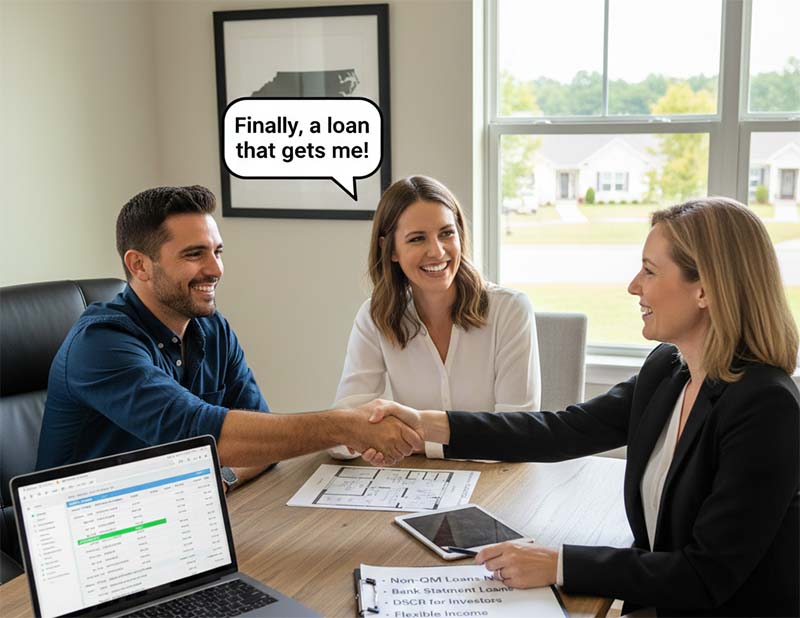
Non-QM loans in North Carolina are different, offering easier approval for self-employed people, investors, and anyone with unusual types of income.
- Options include bank statement loans, asset-based loans, and DSCR loans for investors.
- Non-QM loans are suitable for self-employed individuals, independent contractors, and gig economy professionals.
- Non-QM loans help buyers with good finances or steady income who might not meet the usual loan rules.
Non-Qualified Mortgage (Non-QM) loans are designed for self-employed people, real estate investors, and others with significant assets but irregular income. These loans offer another way to buy a home, but they usually require a larger down payment and a higher credit score. that exceed the limits of a conventional loan. These mortgages, however, are not easy to qualify for.
Jumbo Loans in North Carolina
Jumbo loans are the Jumbo loans are the way to buy luxury homes that cost more than the $832,750 loan limit set for 2026. Jumbo North Carolina mortgage loans are great for expensive homes in Charlotte, Chapel Hill, and Wilmington, but you need very good credit and full proof of your income. Jumbo loans can also help you buy a second home or investment property.
First-Time Homebuyer North Carolina Mortgage Loans
North Carolina offers some of the best first-time homebuyer programs in the country, with options at both the state and local levels. Most programs are run by the North Carolina Housing Finance Agency (NCHFA), which works with local groups to help first-time buyers as much as possible. Tage Mortgage offers down payment assistance and competitively low interest rates. They provide 3% down payment assistance on conventional loans.
For FHA, VA, or USDA loans, they offer a 5% down payment assistance. This down payment assistance is provided through a second mortgage with no interest and no monthly payments.
This second mortgage will be forgiven 20% a year after the 11th year, with total forgiveness after 15 years, as long as the original borrower still lives in the home. To qualify for this program, the home must be in North Carolina, and the buyer must move in within 60 days of closing. The buyer must also earn less than $140,000 per year and have a credit score of 640 or higher. This applies to first-time buyers (who have not owned a home in the last 3 years), veterans, and buyers in certain targeted census tracts. When paired with FHA, USDA, VA, or conventional loans, buyers are eligible for 100% financing.
First-Time Homebuyer in North Carolina? Let’s Get You Pre-Approved
We’ll help you understand down payment requirements, available assistance options, and which loan program fits best—so you can shop with confidence across NC
Down Payment Assistance North Carolina Mortgage Loans
When reserving an NC Home Advantage Mortgage through Online Lender Services, assistance will appear as an option. First-time homebuyers in North Carolina can pick from several loan programs, including FHA, VA, and Conventional 97% loans. They may also get help with their down payment from state and local programs.ng Finance Agency (NCHFA) offers the following:
- Down payment assistance of 3% with the NC Home Advantage Mortgage™
- Up to $15,000 through the NC 1st Home Advantage Down Payment grant for qualified buyers.
- If the homeowner remains in the property for a set period, the assistance is forgiven.
Greensboro, Winston-Salem, and Fayetteville shine as top picks for first-time buyers thanks to their affordable home prices. North Carolina is dotted with regions offering great value, such as Berland County in Fayetteville with its budget-friendly homes and military job opportunities, Guilford County in Greensboro with robust job growth and low prices, Forsyth County in Winston-Salem, where values are rising but still within reach, and Wayne County in Goldsboro, a smart choice for USDA and VA loan seekers.
Local Down Payment Assistance Programs
Many cities in North Carolina offer their own down payment assistance programs.
- In Greensboro, first-time buyers can get up to $15,000 through the Housing Connect Homebuyer Assistance Program for homes within the city limits.
- In Charlotte, DreamKey Partners and HouseCharlotte offer up to 5% of the loan amount as down payment help, along with a fix.
- Similar programs are available in other cities, such as Durham and Raleigh, through their housing departments. Durham and Raleigh.
Getting Easy Loan Approval in North Carolina
The FHA loans are usually the easiest mortgages to get in North Carolina, especially for people with lower credit scores or limited savings for a down payment. To purchase a home with only a 3.5% down payment, individuals must have a minimum credit score of 580 (or possibly lower with a larger down payment). The NC Home Advantage Mortgage reduces that 3.5% down payment further, allowing customers to create 100% financing options. USDA loans require purchasers to meet certain income criteria and be located in qualifying rural areas, but offer simple loans with no down payment.
Affordable Counties In North Carolina To Buy a House
These areas boast lower property taxes, excellent schools, and steady appreciation, making them ideal for buyers planning to put down roots. North Carolina’s programs open the door to homeownership for low- and middle-income residents.
Popular options include the Tage Mortgage™, which offers down payment assistance for FHA, VA, or Conventional loans, and the Community Partners Loan Pool, which provides nonprofit-backed loans to bridge financing gaps.
Many city and county grants are available in Raleigh and Charlotte. Your eligibility depends on your income and loan size, so connecting with a North Carolina loan officer can help you find the perfect fit.
Most Reasonable Cities and Counties to Buy Homes in North Carolina
Many areas of North Carolina have varying levels of affordability, but the following regions are affordable to homebuyers.
- Greensboro: Home prices are lower here than in Raleigh or Charlotte, and there are good assistance programs for buyers.
- Winston-Salem: This place offers good value, with reasonable housing prices and strong job growth in healthcare and education. Fayetteville: Thanks to Fort Bragg, there are affordable housing options for both military and civilian families.
- Rural Counties: Many areas outside Asheville, Wilmington, and the Triangle region qualify for USDA loans.
Remember, when thinking about affordability, consider both home prices and the assistance programs you can use.
How To Secure The Best Mortgage Rates In North Carolina
In order to get the lowest mortgage rate, the following steps are strategically planned:
- Raise your credit score: Aim for at least 740 to qualify for the best rates. Raising your score by 20 points can help even more.
- Compare lenders: Check both local North Carolina lenders and large national banks.
- Shopping around can save you thousands over the life of your loan.
- Lock in your rate: Mortgage rates can change, so apply when you see a rate you like to make sure you get it.
- Bigger Down Payment: If Make a bigger down payment: If you put 20% down, you can avoid mortgage insurance and may qualify for better rates.
- Mortgages are also available in 15-year terms, which have lower rates than 30-year terms but, of course, come with higher monthly payments.
- Watch the timing: Pay attention to economic news and Federal Reserve updates to help you decide when to lock in your rate.
- Choose your loan type wisely: FHA loans offer flexibility, while Conventional loans can lead to bigger savings over time.
- Paying points to lower your interest rate can pay off if you plan to stay in your home for years.
- Even a tiny rate drop, like 0.25%, could save you thousands over the life of your loan.
Assistance With Down Payments and Buying A Home
In North Carolina, you can get help with down payments and closing costs through these programs:
- The NCHFA offers options for North Carolina residents through select lenders.
- Using Multiple Services: A large percentage of buyers can combine federal loan options (FHA, VA, USDA) with state assistance to get the most out of the options available.
- Homebuyer Education: Some buyers may need to complete a homebuyer education class that includes a certification to receive assistance.
- Extra Assistance: More help may be available if the buyer is a teacher, first responder, or someone in a targeted census tract.
- More assistance is also available for teachers and first responders.
North Carolina Mortgage Loans FAQs
Which Mortgage Is The Easiest To Get In North Carolina?
- FHA and USDA loans are generally the most accessible because of flexible credit standards and lower down payment requirements.
In North Carolina, What Is The Minimum Down Payment On A House?
- The minimum down payment depends on the loan type: FHA loans require 3.5%, conventional loans require 3–5%, and VA or USDA loans require no down payment.
In North Carolina, Can I Get Down Payment Assistance?
- Yes, down payment assistance is available.
- The NCHFA and local programs provide grants and forgivable loans to help cover down payment and closing costs.
What About Credit Scores For North Carolina Mortgage Loans?
- Most conventional loans require a minimum credit score of 620, while FHA loans may accept scores as low as 580.
What Areas Offer Affordable Home Buying In North Carolina?
- First-time buyers seeking affordable homes should consider counties such as Cumberland, Guilford, and Forsyth.
North Carolina Mortgage Help Starts Here
Get a quick eligibility review and personalized loan options today
