

Oregon Mortgage Loans: What to Know for 2026 Buyers
This guide covers the various types of Oregon mortgage loans. The process of purchasing a home in Oregon can be complex due to the variety of loan options available. Identifying the most suitable mortgage can simplify the experience. This guide details the primary mortgage types, assistance programs, and strategies for securing an affordable home loan in Oregon, addressing the needs of first-time buyers, veterans, and those seeking rural properties.
Oregon mortgage loans include FHA, VA, USDA, Conventional, Jumbo, and Non-QM options. Find down payment assistance for first-time buyers, the easiest loans to get approved, current mortgage rates, and affordable locations in Oregon.
This guide provides an overview of mortgage loans available in Oregon for 2026, including FHA, VA, USDA, Conventional, Non-QM, and Jumbo loans. It also outlines down payment assistance for first-time buyers, identifies optimal locations for home purchases, and offers strategies for securing competitive interest rates. In the following paragraphs, we will cover the homebuyers guide to the various types of Oregon mortgage loans.
Oregon Mortgage Loans
Oregon’s housing market is still strong, with a good mix of available homes and steady price growth. In cities like Portland and Eugene, rent is often higher than mortgage payments. The median price for a single-family home in Oregon was $499,000 in the first three quarters of 2024. Many people say saving for a 20% down payment is the biggest challenge, especially for communities of color, veterans, and those with lower incomes.
There are several state-assisted loans. Selecting the appropriate loan type is the initial step in obtaining a mortgage. The following section reviews the most common mortgage loan types available in Oregon and which loan type to apply for.
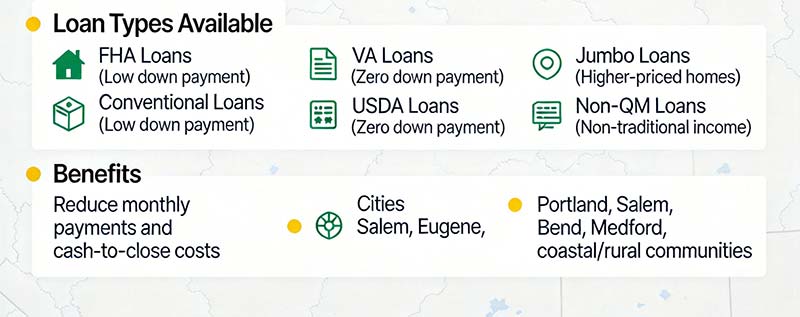
Here’s a look at the most common mortgage loans in Oregon. Oregon home buyers can choose from low-down-payment FHA and Conventional loans, zero-down VA and USDA programs, and Jumbo or Non-QM loans for higher-priced or non-traditional income situations. The right loan can help buyers in Portland, Salem, Eugene, Bend, Medford, and coastal or rural communities reduce monthly payments and cash-to-close costs. Most Oregon lenders offer state housing assistance and first-time homebuyer grants with these loan types.
Oregon Mortgage Loans (FHA, VA, USDA, Conventional, Jumbo, Non-QM)
FHA loans are generally considered the most accessible for first-time buyers, requiring only a 3.5% down payment and a minimum credit score of 580. VA and USDA loans have even less stringent credit and down payment requirements, though they impose specific eligibility criteria. Most conventional loans require a minimum credit score of 620 and have stricter debt-to-income ratio standards. Therefore, the ease of obtaining a loan depends on factors such as credit score, income, military status, and preferred location.
In Oregon, the primary challenge for home buyers is saving enough funds for down payments and closing costs. Oregon offers a variety of programs to address this issue.
Assistance From Oregon Housing and Community Services (OHCOregon Housing and Community Services (OHCS) provides homebuyer funding and two down payment assistance programs through its Flex Lending program, offering loans at below-market interest rates.^3^ These loans, combined with down payment and closing cost assistance, can cover 100% of the required funds. Down payment assistance loans may be combined with closing cost loans, prepaid items, and payment assistance for the full down payment amount. These options are available for primary residences and are accessible to both first-time and repeat buyers.
Refinance in Oregon—Lower Your Rate or Tap Equity
Looking to cut your payment, shorten your term, or cash out (when eligible)? We’ll compare Oregon refinance options and recommend the smartest route for your goals
FHA Oregon Mortgage Loans: Low Down Payment and Credit Flexibility
FHA loans, insured by the Federal Housing Administration, are designed for buyers with lower credit scores. Applicants with credit scores above 580 may qualify for a 3.5% down payment. Borrowers are required to pay mortgage insurance premiums (MIP) for the duration of the loan unless they refinance, relocate, or fully repay the mortgage. FHA loans are particularly suitable for individuals with limited savings for a down payment.
FHA Oregon mortgage loans are government-insured mortgages that let borrowers purchase a home with as little as 3.5% down, with more lenient credit and debt-to-income criteria than Conventional loans.
FHA loans are a great option for Oregon first-time buyers because they require a low down payment and allow those with lower credit scores and savings to qualify. Rent payment history and income also count toward qualification. Many Oregon lenders combine FHA loans with down payment assistance to lower buyers’ expenses.
VA Oregon Mortgage Loans: Zero-Down for Veterans and Service Members
Veterans and active-duty Veterans, active-duty service members, eligible spouses, and some surviving spouses can get a VA mortgage loan in Oregon with 0% down and no monthly mortgage insurance. With flexible underwriting and low rates,
VA loans are often the easiest to qualify for if you have military service. VA loans are available to eligible service members, veterans, and their spouses.
VA loans do not require private mortgage insurance or a down payment and frequently offer competitive interest rates. VA loans are intended for primary residences and are backed by the U.S. Department of Veterans Affairs. For many service members, VA loans are among the most affordable pathways to homeownership in Oregon.
USDA Rural Development Loans for Rural Oregon Properties
USDA loans have income limits and area restrictions, but most of Oregon outside urban centers qualify. Willamette Valley and smaller coastal towns. USDA mortgage loans in Oregon are a great option. To learn more, check out.
Many down payment assistance programs also reserve funding for veterans via USDA. Eligible borrowers can receive 100% financing through Oregon USDA loans in rural and some designated suburban areas, making them ideal for small-town and rural buyers.
100% Financing with No Down Payment. USDA loans provide 100% financing for qualified buyers in designated rural areas and are backed by the U.S. Department of Agriculture. These loans are intended for low- to moderate-income borrowers and do not require a down payment. Instead of private mortgage insurance, guarantee fees apply. Most lenders require a minimum credit score of 580. Property eligibility can be verified using USDA online tools.
Oregon Mortgage Loans for Home Financing: The Standard Choice
Conventional loans, insured by Freddie Mac or Fannie Mae, generally require a minimum credit score of 620. The Conventional 97 program allows for a 3% down payment. Borrowers with stronger credit profiles are more likely to secure better interest rates and lower down payments.
Additionally, conventional loans permit borrowers to discontinue private mortgage insurance (PMI) once 20% equity is achieved. These mortgage loans in Oregon are classified as Conventional Loans.
Not affiliated with FHA, VA, or USDA, they are often the most affordable for borrowers with strong credit, steady income, and a down payment. Most first-time buyers in Oregon can qualify with as little as 3% down, depending on loan type and income. Those with high credit scores and low debt ratios can save on mortgage insurance and have more options for investments and secondary homes.
Oregon Mortgage Loans for Jumbo Financing
Jumbo Oregon Mortgage loans are a great option for buyers. Jumbo Oregon mortgage loans are ideal for buyers purchasing homes in Portland, Bend, and high-end coastal towns.
Jumbo loans are designed for properties exceeding the standard loan limits set by the Federal Housing Finance Agency (FHFA), which are common in high-cost areas such as certain neighborhoods in Portland. Jumbo loans require stronger financial profiles but offer increased flexibility.
High-end homes usually exceed conforming loan limits and require a larger down payment (10-20%), stronger credit, and more financial reserves. Jumbo loans let buyers finance expensive homes with a single loan. ort interest-only loans or ARMs, which may attract higher-paid professionals or those looking to invest.
Oregon Mortgage Loans for Non-QM: Loans with Bank Statements and Other Alternative Documentation
Non-QM (Non-Qualified Mortgage) loans in Oregon are for borrowers outside traditional underwriting guidelines but considered worthy credit risks, such as self-employed individuals, gig workers, and real estate investors. These programs include bank statements, asset-based, DSCR, and interest-only loans.
Borrowers can qualify using alternative documents instead of standard tax forms. Non-QM loans are essential for buyers with recent credit challenges, complex income, or aggressive growth goals who want to buy or refinance a home.
Non-QM Loans: Flexible and High-Value Financing. Non-QM loans are suitable for self-employed individuals, investors, and those purchasing high-value homes. Non-QM loans encompass bank-statement loans, debt service coverage ratio (DSCR) loans for investors, asset-depletion loans, and, in some cases, interest-only loans.
Oregon Mortgage Loans and Buying a House in Oregon
Purchasing a house in Oregon means balancing higher housing costs in some metro and resort areas with lower costs in smaller cities and rural markets. There are stark differences in prices and competition across Oregon, due to its diverse geography, including coastal towns, the Willamette Valley, urban Portland, and high-desert areas like Bend. When selecting a mortgage loan in Oregon, consider local median rates, taxes, HOA or condo fees, and your long-term plans for living in or renting the unit.
Oregon First-Time Home Buyers: What to Anticipate
First-time home buyers in Oregon often face limited inventory in popular metro areas and higher starter-home prices than in most Midwestern or Southern states. FHA, low-down-payment Conventional, VA, and USDA loans, combined with Oregon down payment assistance, can make ownership easier.
Most first-time buyers start with an FHA or 3%-down Conventional loan in more affordable suburbs, smaller cities, or certain areas of Portland, Salem, Eugene, and Medford.
First-time home buyers in Oregon have access to a variety of loan options, including conventional and government-backed loans such as FHA, VA, and USDA. Some program participants may be required to contribute toward the purchase. The Oregon Bond Residential Loan also supports repeat homebuyers who are veterans or purchasing in designated target areas. Income limits, which vary by location and household size, range from $99,200 to $165,200.mits range from $99,200 to $165,200.
Oregon Home Loans When Credit Isn’t Perfect
Late payments, collections, or high DTI doesn’t always stop approval. We’ll match you with the best loan path and tell you exactly what to fix
The Simple Loans to Get Recognized First in Oregon
For most Oregon borrowers, FHA and VA loans are the easiest to get approved for. They have less restrictive credit and debt-to-income requirements. Buyers can also qualify for USDA loans, which are more accessible than other loan programs, as long as they meet income thresholds and the property is in a rural or semi-rural area.
It would be best to view Non-QM loans as specialized solutions rather than ‘easy approval’ options, as they typically come with higher requirements for down payments and interest rates.
Assistance is available in multiple forms, depending on the program. Some programs provide grants that do not require repayment and can be applied directly to a down payment. Zero-interest, forgivable loans: You don’t have to make payments on these loans until you sell the home, refinance, or the mortgage term ends. Low-interest loans feature fixed repayment terms, such as 10 years, and must be repaid accordingly. Certain local home-buying assistance programs prioritize applicants with low or moderate incomes, and some require completion of a homebuyer education course.^8^ For instance, in Springfield, local programs provide up to $7,000 in financial assistance to low-income residents for down payment and closing costs.
Oregon Counties and Cities Where Buying a Home is Realistic
Home buyers in Oregon encounter a wide range of property prices, with the statewide median home price at approximately $499,000. More affordable options are available outside the Portland metropolitan area, particularly in the Willamette Valley, Southern Oregon, and regions east of the Cascades, where both home prices and the cost of living are lower.
Rural Development Loans provide no-money-down financing in semi-rural and rural counties, further increasing affordability. Thorough market research can help buyers identify cost-effective areas and maximize their purchasing power.
It is possible to rank counties and cities in Oregon in a reasonable fashion by balancing home prices with local income and job opportunities, as well as lifestyle necessities. Numerous rankings suggest that smaller and mid-sized cities and communities around Portland and Bend are more economically viable while still offering services and amenities.
Homebuyers in Oregon’s Cities and Counties that are Affordable
Recent home affordability surveys in Oregon highlight communities like Pendleton, Klamath Falls, and La Grande, as well as other southern and eastern cities, as having median home prices well below the statewide average. Coos Bay and other coastal or regional hubs are also identified as less expensive than Portland’s core neighborhoods. Communities in the Salem and Mid-Willamette Valleys are typically less expensive than Portland and Bend, while still offering strong job opportunities and convenient commuting.
Home buyers in Oregon often invest significant time seeking properties that align with both their budget and requirements. Additional research may reveal homes in or near more affordable areas.
The highest cost of buying a home is usually the loan. Lowering your interest rate can save you thousands of dollars. Here are some ways to get the best rate on an Oregon home loan. Improving credit scores can enhance eligibility for more favorable mortgage interest rates. A minimum score of 620 is required for conventional loans, while FHA loans require a minimum score of 580.
How To Get The Lowest Rate On Oregon Mortgage Loans
Increasing credit scores before applying may result in better loan terms.
- Down Payment: A larger down payment can result in a more favorable interest rate.
- For conventional loans, a 20% down payment eliminates the need for private mortgage insurance, further reducing costs.
- Even a 5% or 10% down payment can be beneficial.
- Comparing offers from multiple lenders is recommended, as rates and fees vary.
- Online tools can help evaluate current mortgage rates and quotes.
- These options offer interest rates below the market average, which can be much lower than what you’d find elsewhere.
- If you qualify, this is one of the best ways to get a low rate.
Rate protection is available through rate locks, which safeguard borrowers from market fluctuations during the loan processing period once a satisfactory rate is identified.
Nearly Congested Housing with Depth, Absenteeism, and Lifestyle
The majority of buyers looking to purchase real estate in the state of Oregon are particularly interest Most buyers looking to purchase real estate in Oregon are interested in more affordable areas farther from Portland, Salem, and Eugene than the densely urbanized regions, are just as important as price when relocating families and remote workers. You can use your lender’s pre-approval numbers and local MLS data to identify neighborhoods and counties with your long-term goals for payments, taxes, and lifestyle.
Housing Assistance and Down Payment Assistance in Oregon
Both the local and state levels in Oregon offer down payment assistance and housing programs that help low- to moderate-income first-time homebuyers make homeownership more feasible. These programs can be layered on top of an FHA, VA, USDA, or Conventional loan, which means they can help with closing costs and reduce the cash down payment requirement.
Down Payment Assistance from Oregon Housing and Community Services (OHCS)
The Down Payment Assistance program from Oregon Housing and Community Services (OHCS) is offered to eligible first- and first-generation homebuyers who are at or below 100% of the area’s median income. Part of the funding is reserved for state veterans, and the homebuyer must complete a first-time homebuyer education course and have a counseling session with a certified housing counselor. The assistance can be used for down payment and/or closing costs and is offered through local partners to communities statewide.
City and Regional Oregon First-Time Home Buyer Programs
Portland and other Oregon cities offer additional first-time homebuyer and down payment assistance programs at the local level, along with statewide options. Portland’s Down Payment Assistance Loan (DPAL) program provides a 0% interest loan with deferred payments and possible forgiveness after 15 years if you meet program requirements. Springfield offers down payment assistance through DevNW, where qualifying first-time buyers can receive up to $25,000 in interest-free assistance, repayable when the home is sold or refinanced.
How Oregon Housing Assistance Pairs with Mortgage Loans
Oregon housing assistance can be combined with FHA, VA, USDA, and Conventional loans as a second mortgage, forgivable lien, or grant, depending on the program. First-time homebuyer program partners help buyers consolidate loans and cover part of the down payment or closing costs. This is most effective in reducing cash needed at closing, especially in high-priced markets, if you complete the required courses and meet income, purchase price, and occupancy requirements. The most popular mortgage loans for Oregon homebuyers vary by region, price, and buyer profile, but certain trends have emerged statewide.
Mainstream Loan Options in Oregon
FHA loans and low-down-payment conventional loans are the most commonly used options for first-time home buyers and move-up buyers in Oregon. In rural and lower-population areas, USDA loans are frequently used because they offer 0% down to eligible buyers in the right areas. VA loans are also great options, offering 0% financing, no monthly mortgage insurance, and competitive rates. VA loans are used more frequently in areas with a more extensive veteran population.
Oregon Mortgage Loans That Are High End And Niche
Jumbo loans are more common in higher-priced areas of Portland, Bend, and some coastal regions where prices exceed conforming loan limits. Non-QM loans are a smaller but important segment, helping self-employed buyers, investors, and those with complex finances who cannot prove income through traditional W-2s and tax returns. Oregon buyers across all income levels and property types can use these loans to find suitable financing.
How to Get the Best Rate on an Oregon Home Loan
The best rates on an Oregon home loan are earned through adequate preparation, smart planning, and shopping around. Even with small rate improvements, borrowers can save thousands of dollars over the full term of a 30-year mortgage.
Improve Your Profile for a Mortgage In Oregon
Most lenders in Oregon reserve their most competitive prices for certain types of borrowers – ones with high credit scores, low debt-to-income ratios, and stable and consistent employment history. Steps like paying off your revolving debt and maintaining a consistent income for 2 years can help you qualify for better rates. Furthermore, for Conventional loans, Mortgage Insurance rates and down payment requirements can also improve with a slightly higher down payment.
Denied a Mortgage in Oregon? Get a Second Opinion
Many denials come from lender overlays, not the actual guidelines. We’ll review your scenario and help you find a workable loan option with clear next steps
Evaluate Different Mortgage Lenders and Loan Options in Oregon
Mortgage lenders differ in rates. One Oregon mortgage lender can be more competitive with FHA loans. Mortgage lenders offer different rates. Some are more competitive with FHA loans, others with Conventional or Non-QM loans. To evaluate market rates, get at least two or three quotes from lenders familiar with Oregon down payment assistance. For accurate comparisons, request comparable Loan Estimates with rates, APR, points, and fees from each lender on the same day.
Locking Your Rate On Oregon Mortgage Loans
- Locks, timing is important, as rates can depend on the economy, the bond market, and expectations from the Federal Reserve, making the right strategy for your rate lock vital.
- When shopping in a slow market, discuss float-down options and lock windows with your lender, as Oregon markets may require quick closings.
- Managing your lock period through inspections, appraisals, and closing helps you avoid extension fees.
Oregon Mortgage Loans FAQs
Which Mortgage Loan Is Easiest To Obtain In Oregon?
- For most borrowers, FHA Oregon mortgage loans represent the most accessible Oregon mortgage loans due to the minimal credit score and debt‑to‑income restrictions.
- VA loans are sometimes even more beneficial for qualifying veterans and servicemen because they offer zero down payment, relaxed qualifying criteria, and no monthly mortgage insurance.
Is It Possible To Get A Mortgage Loan With No Down Payment In Oregon?
- Qualified borrowers can obtain zero‑down financing in Oregon via VA and USDA loans.
- Additionally, some down payment assistance and housing programs can be combined with FHA or Conventional loans to achieve zero or near-zero out-of-pocket down payment.
Which Programs Are Available For First‑Time Home Buyers In Oregon?
- In Oregon, first-time home buyers can access a variety of programs, both at the state level and for individual cities, including down payment assistance from OHCS, as well as Portland’s Down Payment Assistance Loan and DPA programs in Springfield.
- These applications typically involve costs associated with buyer education, maximum income thresholds, maximum purchase price thresholds, and owner-occupancy requirements.
Where In Oregon Can I Find The Cheapest Homes For Sale?
- Pendleton, Klamath Falls, La Grande, and Coos Bay are examples of affordable cities in Oregon that rank high in the latest affordability surveys.
- When comparing housing affordability in Oregon, the Mid-Willamette Valley and Salem rank similarly to Portland and Bend, and offer job and service opportunities.
For Oregon Mortgage Loans, Do I Need To Use An Oregon-Specific Lender?
- You can choose any lender licensed in Oregon, whether regional or national.
- However, when choosing lenders with better experience and understanding of Oregon markets, you can choose any lender licensed in Oregon, whether regional or national.
- Lenders with more experience in Oregon markets can better manage local guidelines, appraisal processes, and program requirements for state or city assistance.
- Knowledge of rental properties and non-QM Oregon mortgage loans.
- Such lending programs are designed to qualify borrowers based on the rental property’s cash flow or other income documentation, rather than tax returns.
Final Thoughts on Oregon Mortgage Loans and Buying a Home in Oregon
Oregon mortgage loans include FHA, VA, USDA, Conventional, Jumbo, and Non-QM options. This variety appeals to first-time buyers, luxury buyers, and self-employed buyers with complex finances. Oregon down payment assistance, city grants, and careful lender shopping can help you secure a strong loan with a good rate and manageable payment for your preferred city or county.
Oregon Mortgage Loans That Fit Your Budget and Credit
Buying or refinancing in Oregon? We’ll help you compare FHA, VA, USDA (eligible areas), Conventional, Jumbo, and Non-QM options—then map out the fastest path to approval
