
SBA Loans for Small Business Financing Guide for 2025

It ain’t easy being a small business owner. With rising expenses, salaries, and keeping demand up, numerous owners feel they require extra capital. That is where SBA loans for small business enter into the picture. The U.S. Small Business Administration-backed loans help entrepreneurs obtain access to low-cost funds when traditional loans are just out of reach. In this guide, we’ll break down everything you need to know about SBA loans in 2025, how they work, types of loans available, requirements, pros and cons, and how to apply. If you’re ready to grow your business, this could be the financing solution you’ve been looking for.
What Are SBA Loans for Small Business
SBA loans for small business are financing option designed specifically to support small businesses. Unlike traditional bank loans, SBA loans are supported by a partial guarantee from the U.S. Small Business Administration, reducing lender risk. This guarantee means the lender takes on less risk, making it easier for small businesses to get qualified. The SBA doesn’t lend money directly. Instead, it partners with banks, credit unions, and lenders like Gustan Cho Associates to issue the funds. For small business owners who may not qualify for regular bank financing, SBA loans open the door to affordable, long-term funding.
Need Funding to Grow Your Business?
Our SBA loan guide shows you how to qualify, apply, and get approved.
Applying For SBA Loans for Small Business
The function and role of the Small Business Administration is to promote and encourage entrepreneurship. Hard-working Americans who want to fulfill their American Dream of business ownership but do not have the knowledge or someone to guide them in the right direction.
The hard part to qualifying and getting approved for SBA loans is to make sure that you have gathered all of the information ready for processing. Many talented entrepreneurs capable of owning a small business do not even consider becoming a business owner.
So many entrepreneurs do not even try to explore the realm of possibility. Many feel they do not have enough down payment and credit profile to qualify for a traditional commercial loan. However, entrepreneurs do not realize how a mortgage lender like Gustan Cho Associates can help them qualify and be approved for SBA loans.
Getting Approved For Small Business Loans
Applying For Small Business Loans is streamlined. Whether you go to one SBA commercial business lender or another SBA Lender, the forms you need to complete are similar. SBA loan applications are uniform and standard. You must not complete different forms when applying for SBA loans for small business.
All documents that are required for small business loans are similar. You already have the whole application and document package if you do not qualify with one particular lender you can submit the same application to a different lender for SBA loans.
It will be easy for you to submit your whole file to a different SBA Lender. Your commercial mortgage broker will help you package up these loan documents required. You may need to complete one generic Small Business Loans application and have one standard Personal Financial Statement.
Starting The SBA Loan Process
Typical items required for business loans are completing the commercial application, similar to the residential application. Business owners must submit personal and business tax returns for the past three years. Business owners need to prove their experience and educational background. Personal financial statement. Profit and loss statement of your current business. If a new business, a current and past profit and loss statement, and a pro-forma profit and loss statement. Detailed, easy-to-read, comprehensive resume of each business partner. A resume is needed to prove management’s business experience, technical training, certificates earned, active licenses, and educational background. Provide complete, legible documents required to start the SBA loan process.
Preparing Business Plan For SBA Loans For Small Business
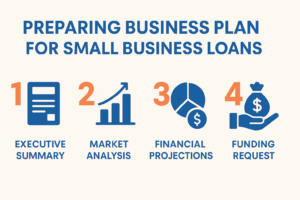
All loan programs require a business plan for start‐up businesses. This plan should include projected financial statements, including profit and loss, cash flow, and balance sheet. The lender will review credit heavily for individuals starting a business. Explain periods of bad credit, prior bankruptcies, prior foreclosures, judgments, and periods of bad credit. Letters of recommendation by vendors, lenders, colleagues, and professionals in your industry. If they are already in business, most commercial loan programs will also require the previous year’s tax returns for the business and the person. This is usually true for anyone who owns at least 20% of the business. AR/AP ‐ Depending on the loan type, accounts receivable and accounts payable information may be required.
Collateral Requirement For SBA Loans for Small Business
Collateral ‐ Collateral requirements vary greatly. The lender goes after collateral when borrowers default on their commercial loan obligations. The more collateral the borrower has, the more skin in the game the borrower has and the less risk the commercial lender has. Loan-to–value is the loan balance divided by the property’s market value. The lower the LTV, loan-to-value, the safer the lender is because of the amount of equity the borrower has. There are some commercial loan programs that do not require collateral.
Every case on commercial loans is unique, and there are many factors a lender will assess risk on a borrower plus the deal at hand. Many types of paperwork are required for a borrower applying for an SBA loan. Your commercial loan broker will help you prepare the necessary paperwork the SBA lender requires.
Secure the Capital Your Business Needs
Apply Now And Get Discover how SBA loans can help you expand, refinance debt, or buy equipment in 2025.
Documents And Paperwork Required On Small Business Loans
Depending on a business loan’s specific requirements, your Commercial SBA Lender will most likely require you to submit one or more legal documents to proceed with your request for an SBA Loan for your business. A letter of explanation or presentation on how you plan on making your business successful. Business and commercial loans have a higher degree of risk versus residential loans. Commercial loans with a higher degree of risk of default and will require collateral from the commercial lender. Documents required for SBA loans from small business owners include business licenses and registrations required for conducting business and a business plan. A summary of your business’s history, experience, goals, and why they should give you the funding.
Tips for Maximizing Success with SBA Loans
To optimize the chances of obtaining SBA loans for small business and maximizing its benefits, small business owners should consider the following tips:
- Understand Loan Programs: Familiarize yourself with the various SBA loan programs and select the one that best suits your business needs and objectives.
- Prepare Documentation: Ensure you have all the necessary documents and information before applying for an SBA loan. This includes business plans, financial statements, tax returns, and personal financial information.
- Maintain Good Credit: Maintain a good credit history by paying bills on time, reducing debt, and addressing any discrepancies or errors in your credit report.
- Build Relationships: Establish relationships with lenders and financial institutions participating in SBA loan programs. Networking and building rapport with lenders can improve your chances of securing financing.
- Seek Professional Assistance: Consider seeking assistance from financial advisors, accountants, or business consultants who can help you navigate the SBA loan process and optimize your loan application.
What Business Lenders Like To Hear?
SBA borrowers need to keep the fact that there are many commercial loan options, more documents may need to be provided by your SBA Lender forms that need to be completed, and information required. Business Lenders love a good story backed by facts: Exhibits, proven track records, experience, growth statistics, and proposed realistic goals.
- Articles of Incorporation of your business
- Copies of contracts you have with any third parties, vendors, business affiliates
- Franchise agreements, partnership agreements, LLC agreements, if applicable
- Commercial leases and other liabilities that your business has, as well as assets and accounts receivables
You will receive the necessary, proper documents that need to be provided by your SBA commercial loan officer and other forms that may need to be completed depending on your Small Business Loan Program. Your SBA loan officer will provide proper instructions on your submission requirements and specific instructions for each deal.
How Do Small Business Lenders Process SBA Loans
Your loan officer can work with his or her commercial loan processor or direct you to the Small Business Lender directly, where the direct SBA Lender may do all the work. Besides the standard docs, certain types of docs are necessary for you to submit regarding SBA loans. Each Small Business loan program has its own specific forms that need to be completed by the borrower. However, most required documents and forms are the same as every Small Business Loan lender.
Frequently Asked Questions (FAQs): SBA Loans for Small Business Financing Guide for 2025
1. What are SBA loans for small business?
SBA loans for small business are financing offered by banks and lenders in partnership with the U.S. Small Business Administration (SBA) to provide small business owners with affordable capital for various business needs.
2. What types of SBA loans are available?
The SBA offers several loan programs, including the 7(a) Loan Program, Microloan Program, CDC/504 Loan Program, and Disaster Loan Program, each tailored to different business needs and circumstances.
3. What are the benefits of SBA loans for small business owners?
SBA loans offer benefits such as lower interest rates, longer repayment terms, flexible eligibility requirements, and support for underserved communities, making them an attractive financing option for small businesses.
4. Who is eligible for SBA loans for small business?
Eligibility requirements vary based on the specific loan program and lender, but commonly encompass aspects such as the status of the small business, good credit history, owner’s equity contribution, ability to repay, and collateral.
5. How do I apply for SBA loans for small business?
In order to apply for an SBA loan, small business proprietors should gather necessary documentation, select a participating lender, complete the loan application, undergo underwriting and approval processes, and finalize closing and disbursement of funds.
6. What can I use an SBA loan for?
SBA loans for small business can be use for different business purposes, including working capital, equipment purchases, inventory, real estate acquisition, debt refinancing, and recovery from declared disasters.
7. How long does it take to get approved for an SBA loan for small business?
The approval timeline for SBA loans for small business varies depending on factors such as the loan program, the lender’s processing time, the application’s completeness, and the borrower’s creditworthiness. Still, it typically ranges from several weeks to a few months.
8. How should I increase my chances of getting approved for SBA loans for small business?
To improve the likelihood of approval, small business owners should understand the loan programs, prepare thorough documentation, maintain good credit, build relationships with lenders, and seek professional assistance if needed.
9. What will happen if I default on an SBA loan?
In case of non-payment or default, the lender may take legal action to recover the outstanding debt, including seizing collateral, pursuing guarantors, and reporting delinquency to credit bureaus. The SBA may also intervene to assist with debt resolution and recovery efforts.
10. Are SBA loans for small business available for startups?
Yes, SBA loans for small business are available for startups. However, eligibility criteria may be stricter, and lenders may require additional documentation and collateral to mitigate risk associated with new businesses.
Bottom Line – Are SBA Loans Right for Your Small Business?
If you’re a small business owner in need of funding, SBA loans for small business can be a powerful solution. With lower rates, longer terms, and flexible uses, they provide financing that helps businesses grow without crushing debt.
At Gustan Cho Associates, we work with entrepreneurs across the country to secure SBA loans and other financing solutions. Even if you’ve been turned down by traditional banks, our team knows how to navigate the process and help you get approved.
If you are interested in knowing more about SBA loans for small business or if you need to know whether a specific business loan qualifies for an SBA loan, please get in touch with us at Gustan Cho Associates at gcho@gustancho.com or call Gustan Cho at 800-900-8569, text for faster response. The team at Gustan Cho Associates is available seven days a week, evenings, and weekends.
Make Your Business Growth Year
Learn how SBA loans can provide affordable financing with low rates and flexible terms.