

2026 Homebuyers Guide To Utah Mortgage Loans
Utah Mortgage Loans: FHA, VA, USDA, Conventional, Jumbo, Non-QM Home Loans 2026
Utah homebuyers can choose from several mortgage options, such as FHA, VA, USDA, conventional, jumbo, and Non-QM loans. First-time buyers often consider FHA loans or down payment assistance, while those who qualify may be eligible for USDA or VA loans with no down payment. The right loan depends on your credit, income, down payment, and the home’s location and value.
Learn about Utah mortgage loans, including down payment help, first-time homebuyer assistance, and options like FHA, VA, USDA, conventional, jumbo, and Non-QM loans.
Utah mortgage loans help you buy or refinance a home in Utah. The loan program you qualify for depends on your credit, income, down payment, the home’s value compared to county loan limits, and whether you need a jumbo loan. Most homebuyers are unaware of the numerous mortgage options available in Utah. Picking the right loan could save you money and make it easier to get approved. In this guide, you will find options for first-time buyers, people new to the Wasatch Front, and anyone looking for bigger loans in more expensive neighborhoods. At GCA Mortgage Group, we simplify the process by adhering to the standard guidelines for FHA, VA, USDA, and conventional loans, with no additional steps required. Our straightforward approach helps you find the loan that best suits your needs.
Overview of Mortgage Loans in Utah
The following are the most common mortgage loans used by buyers in Utah.
- FHA loans help first-time buyers and individuals with limited credit history because they have more lenient credit requirements and lower down payment options.
- VA loans are for qualified veterans and usually let you buy a home with no down payment.
- These loans also have more lenient credit and income requirements.
- USDA loans allow buyers in certain rural and suburban areas to purchase a home with no down payment.
- Both you and the home must meet USDA rules.
- Conventional loans are suitable for buyers with good credit and steady income, offering various options and terms.
- They typically require higher credit scores and larger down payments than FHA, VA, or USDA loans.
- If you want a home that costs more than the usual loan limit, jumbo loans can help.
- Non-QM loans are another option for buyers who do not meet the usual requirements. Instead of regular income paperwork, you might qualify by showing bank statements or the money your property brings in.
Ready to Buy a Home in Utah?
From Salt Lake City, Provo, Ogden, and Layton to St. George and smaller towns, we offer flexible Utah mortgage loans for first-time and move-up buyers
Who Needs Utah Mortgage Loans?
- First-time homebuyers in Utah who want a mortgage with a low down payment.
- Buyers moving to Utah who need quick approvals and to make competitive offers.
- Buyers who are veterans or on active duty may qualify for loans backed by the Department of Veterans Affairs.
- Buyers in rural or suburban areas who want to use USDA financing.
- Buyers who are self-employed and want to use bank statements instead of tax returns.
- Buyers who need a large mortgage may require a jumbo loan.
- Real estate investors who use DSCR or other Non-QM loans.
What To Expect When Buying A Home In Utah In 2026
Utah’s housing market is expected to remain competitive. According to Zillow, typical home values range from $500,000 to $600,000. As a result, many buyers will likely continue using down payment assistance and low down payment loan programs. (Zillow, 2023)
With home prices shifting from county to county across Utah, it pays to have a smart game plan before you buy.
- Some counties, especially resort or second-home areas, have prices well above the state average.
- In other counties, affordability is on your side, giving you more breathing room in your monthly budget.
As new market data comes in, this guide will highlight the best areas for buyers. FHA loans remain popular among first-time buyers due to their more lenient credit and down payment requirements, as well as a simpler approval process.
What customers appreciate about Utah’s FHA opportunities
- Down payments can be as low as 3.5% with qualifying credit.
- FHA loans have more lenient credit history guidelines than conventional loans.
- Many first-time buyers discover that FHA loans pair perfectly with homebuyer assistance programs, making homeownership more attainable.
FHA loans are suitable for individuals who want an easy approval process, are trying to build credit, or do not have a large amount saved for a down payment.
VA loans offer big benefits for veterans, active-duty service members, and some surviving spouses.
- Typically, no down payment is required.
- You do not have to pay monthly mortgage insurance, and the qualification rules for VA loans are often easier than those for other programs.
Best for
VA loans are ideal for those who qualify and want the lowest possible monthly payments.
Utah USDA Mortgage Loans
USDA loans let you buy a home with no down payment, but your new home must be in a qualifying rural or suburban area.
Consult the USDA eligibility maps to determine if a Utah address qualifies. The USDA or Rural Development makes the final determination on property eligibility. USDA loans are best for buyers seeking full financing and willing to live in eligible rural or suburban areas.
Conventional mortgages are a top choice for buyers with strong credit who want numerous options and a straightforward application process.
Reason borrowers like conventions the most
- Borrowers with excellent credit often enjoy the best rates and pricing.
- 10/15/20/30-year options
- Conventional loans shine for repeat buyers. Conventional loans work well for people buying another home or anyone wanting to refinance with a steady income and a desire for a variety of loan choices; conventional loans could be your best fit.
Utah Mortgage Loans Of The Jumbo Kind
If your dream home costs more than your county’s usual loan limit, you will need a jumbo loan. For 2026, the limit for a single-unit home is $832,750, but it can be higher in more expensive counties.
Jumbo loans are the best choice for buyers in expensive areas who need to borrow more than the usual limit.
While most lenders require standard income documentation, Non-QM loans employ alternative methods to qualify. In Utah, popular non-QM options, such as bank statement loans, are particularly helpful for self-employed buyers.
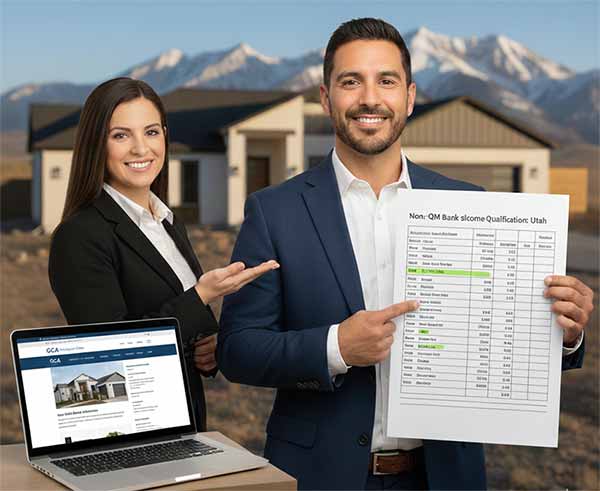
- DSCR loans (investor-centric; qualify based on property cash flow)
- Asset depletion (qualify based on your savings or other money you have, instead of your income), options (provide payment flexibility)
- ITIN and other special programs (offered by some lenders) help self-employed buyers, people with complicated taxes, or anyone investing in property with a DSCR qualification.
Looking to Refinance Your Utah Home?
Lower your payment, pull cash out, or switch programs with our full menu of Utah refinance mortgage loans
Utah First-Time Home Buyers
First-time homebuyers in Utah may find the variety of available loan types overwhelming. Understanding the mortgage loan options and exploring down payment assistance programs can help secure favorable rates and streamline the process.
This guide outlines Utah housing assistance programs and affordable housing options, covering all major loan types, including VA, FHA, jumbo, and non-QM loans.
First-time homebuyers in Utah may find the variety of available loan types overwhelming. Understanding the mortgage loan options and exploring down payment assistance programs can help secure favorable rates and streamline the process. This guide outlines Utah housing assistance programs and affordable housing options, covering all major loan types, including VA, FHA, jumbo, and non-QM loans.
Categories of Utah Mortgage Loans
Utah FHA Loans
FHA loans are federally insured and are typically preferred by first-time homebuyers due to their low down payment requirements. In Utah, FHA loans are available with a minimum credit score of 580 and a 3.5% down payment. Applicants with scores between 500 and 579 may still qualify, but they must provide a 10% down payment. FHA loans require mortgage insurance premiums (MIP), which remain in place until the loan is refinanced, the property is sold, or the loan is paid off.
Utah Veterans and VA Loans
VA loans are only for veterans. Active loans are available exclusively to veterans, active duty service members, and qualified surviving spouses. These loans require no down payment, offer lower interest rates, and do not require private mortgage insurance (PMI). Applicants must obtain Veterans Grant Status Validation from the Utah Department of Veterans and Military Affairs to qualify.
USDA Loans in Utah
.USDA loans are available for properties located in qualified rural areas. These loans require no down payment and are sponsored by the Department of Agriculture. Credit score requirements are generally more lenient, typically ranging from 580 to 620.
Conventional Loans in Utah
Conventional loans are not government-backed and typically require higher credit scores (620 or above). A down payment of 3-5% is common, with a standard 20% down payment required to avoid private mortgage insurance (PMI). These loans are best suited for borrowers with strong credit and a stable income.
Jumbo and Non-QM Loans
Non-QM loans (Non-Qualified Mortgages) provide flexible underwriting for borrowers who do not meet standard lending criteria. Jumbo loans are designed for loan amounts that exceed the conforming loan limit and are often used for high-value properties, such as those in Salt Lake County.
Utah Housing Assistance And Utah Down Payment Assistance
Qualified buyers may be eligible for state programs that offer assistance with down payments or closing costs. The First-Time Homebuyer Assistance Program in Utah, established by Senate Bill 240 and administered by Utah Housing, outlines specific eligibility criteria and limits on assistance, as well as qualifying home prices. Utah Housing offers programs and shares reports that show their support for moderate-income families, including helpful down payment assistance.
Local Programs May Also Be Available.
Many cities and counties offer their own homebuyer assistance programs, typically based on income and with limited funding available. For example, Davis County offers a loan program with clear public rules. Since local programs can come and go with funding changes, it is wise to check with your city or county housing department to determine which programs your lender approves.
Utah Mortgage Loans That Are Easy To Get Approved For
The ease of loan approval depends on your own situation. In many cases, the loans are available for first-time buyers, thanks to their low down payment requirements and flexibility for those with less-than-perfect credit.
- USDA loans can be the most budget-friendly choice, offering zero down payment if your property and finances meet the guidelines.
- VA loans are often the best choice for eligible veterans, offering flexibility and no monthly mortgage insurance.
- Self-employed individuals or those with significant business deductions may struggle to demonstrate sufficient income.
- Non-QM loans are made for these situations.
- Home affordability is always changing.
- This guide highlights Utah’s best-value places, focusing on areas where home prices are below the state average.
The median home value in Utah is approximately $526,140, according to Zillow.
Moving to Utah for Work or Lifestyle? Get Pre-Approved Before You Arrive
New job in Utah, remote work, or just chasing the mountains and sunshine—we’ll help line up your financing
Typical Values In A County: Sample – Carbon County
- In Carbon County, home values are often in the high $200,000s or less, making it easier to afford a home.
- Ogden is a popular choice for buyers seeking value along the Wasatch Front, as home prices are below the state average.
- Home values in Weber County and Tooele County have recently approached the state average.
- Some affordable areas may come with trade-offs, such as longer commutes to work or higher fees, property taxes, or insurance costs.
- These things can affect your budget even more than your loan’s interest rate.
- Knowing your loan limits helps you decide if you need a standard or jumbo mortgage. a tool, which lists county loan limits for Utah for 2026.
- However, these may not always be up to date.
- It is advisable to consult authoritative sources for the most recent FHA limits.
- The 2026 conforming loan limit for a single-unit property is $832,750, with higher limits in designated high-cost areas.
- FHA loans, combined with assistance programs, are a great choice for first-time homebuyers.
- They are also good for buyers with strong credit who need flexibility.
- VA loans give veteran buyers some of the best payment options available.
- Jumbo loans are designed for buyers in high-priced counties or markets.
- Non-QM loans are a smart solution for self-employed buyers and real estate investors.
Many Outside And Personal Factors Can Affect Your Loan Rate, And You Can Control Many Of Them Credit Is About More Than Just Raising Your Credit Score
- Pay down credit card balances, avoid opening new accounts before closing existing ones, and correct any mistakes on your credit report.
- Pick the right loan program first, then focus on getting the best price.
- Getting a good rate on the wrong loan can cost you more than taking a higher rate on the right loan.
- As you get closer to closing, consider rate lock options ahead of time so you are not making last-minute decisions.
- For some loans, a bigger down payment or extra cash reserves can help you score better pricing.
- Always aim for a full pre-approval, not just a pre-qualification.
- A strong application can expedite your approval and give you a competitive advantage when it is time to negotiate.
If a bank or lender turns you down, it is often due to additional rules called overlays. We work to reduce these extra requirements, follow standard guidelines, and help you find the best approval path, whether it is FHA, VA, USDA, conventional, jumbo, or Non-QM. Let us help you map out a winning plan. Tell us about your credit, income, and goals, and we will match you with the best mortgage options Utah has to offer.
Utah Mortgage Loan Checklist: From Pre-Approval to Closing
Use this checklist to stay organized and avoid delays during your Utah mortgage process.
For Step 1: Getting Ready to Apply: (1-3 days)
- Collect your pay stubs, W-2s (or self-employed docs), and bank statements.
- Avoid making large purchases, such as cars, furniture, or opening new credit cards.
- Avoid transferring funds between accounts without tracking.
- If you are self-employed, remember that your qualifying income may be lower than your gross income.
Step 2: Getting Pre-Approved (same day to 24-48 hours if documents are ready)
- Fill out a complete loan application (instead of just a brief quote).
- Be prepared to provide proof of income, assets, and identification to avoid any unexpected issues.
- Inquire with your lender to determine which loan type is best for you: FHA, VA, USDA, conventional, jumbo, or Non-QM.
- Obtain a customizable pre-approval letter.
Step 3: Define Your Price Point (same day)
- Determine a monthly payment amount that feels comfortable for you, rather than the maximum you qualify for.
- Include all expenses in your budget, such as taxes, homeowners’ insurance, HOA dues, and mortgage insurance if needed.
- Determine your down payment strategies and whether you plan to use down payment assistance from Utah.
Step 4: Start your home search (variable)
- Make a list of your must-haves and nice-to-haves for your new home.
- If you plan to use USDA, confirm the home’s area eligibility before you proceed.
- If you need a jumbo loan, learn about the reserve and document requirements ahead of time.
Step 5: Make an Offer (same day)
- Make sure to use the right loan type when making an offer (if you change this later, it can slow down the closing process).
- Consider how your closing date will affect the timing of your home inspection.
- You can ask your lender to contact the seller’s agent to help strengthen your offer.
Step 6: Loan Processing and Underwriting (first week)
- Send any missing documents to your lender as soon as possible.
- Respond quickly to any requests for updated bank statements or pay stubs.
- Avoid changing jobs or making major changes to your bank account during the loan process.
Step 7: The Appraisal and Title Work (1 – 2+ weeks depending on the state of the market)
- An appraisal checks the value and condition of the property to meet your loan’s requirements.
- Title work ensures there are no problems with ownership, liens, or the property’s legal description.
Step 8: Clear the Conditions ( the final 1 – 2 weeks)
Here are some common issues that can delay your closing:
- Deposits that haven’t been accounted for
- New inquiries on your credit report
- Job changes or a reduction in work hours
- Pages are missing from your bank statements
- Late documents from self-employed borrowers
Step 9: Clear to Close (final days)
- Review your Closing Disclosure carefully.
- Ensure that your closing funds and wire instructions are accurate and ready.
- Schedule your final walkthrough of the property.
Step 10: Closing Day
- Please bring a valid ID with you to the closing.
- Be ready to sign the final documents at closing.
- You will get your keys after the transaction is funded and recorded. This may take some time, so please be patient.
Step 11: What to do after closing (first 30 days)
- Arrange your mortgage payments and understand how escrow will work.
- Keep your closing documents in a safe place.
- If you plan to make another purchase soon, refrain from applying for new credit at this time.
Buying a Second Home or Vacation Property in Utah?
Reach out today and let us match you with the right Utah mortgage loan program for your second home or investment property
Utah Mortgage Loans FAQs
What Are Utah Mortgage Loans That Are Easiest To Qualify For?
- FHA for first-time buyers, VA for qualifying veterans, and USDA for eligible properties.
How Much Of A Credit Score Do You Need To Buy A House In Utah?
- Depends on the right program (FHA/VA/USDA/conventional/Non-QM).
- The right answer is to select the loan first, and then set a score target.
Does Utah Offer Down Payment Assistance?
- Yes, but it is a matter of funding/eligibility within programs under Utah Housing and certain county/city options.
Is It Possible To Buy A House In Utah With No Money Down?
- Yes, but only under VA or USDA.
- Please note that with USDA, the house must be located in an eligible area, and USDA/RD makes the final determination on eligibility.
What Is The Household Income Limit For Down Payment Assistance In Utah?
- Assistance programs are usually income-restricted, and limits also depend on the county and program; therefore, stay up to date with the administrative website for the program.
What Will Be The FHA Loan Limits On Utah Mortgage Loans For 2026?
- The limits for FHA loans vary by county, which should be confirmed using the official HUD FHA Mortgage Limits lookup.
What Will The Conforming Loan Limits For 2026 Be On Utah Mortgage Loans?
- For a single-unit property, the conforming loan limit for 2026 is $832,750, which will increase in some high-cost counties.
When Should I Get A Jumbo Loan In Utah?
- If your loan amount exceeds the conforming limit for your county (or if you are using a jumbo-specific product for other reasons).
Is It True That Self-Employed Borrowers Can Get Utah Mortgage Loans Without Tax Returns?
- Often, but not always, with the Non-QM bank statement or asset-based loan programs (guidelines differ by lender).
- In general, you will need to provide IDs, income verification, and self-employed documentation, as well as asset or bank statements, and a credit authorization form.
- The loan type will determine which additional documents you are required to provide.
What Documents Do I Need For A Utah Mortgage Pre-Approval?
- Typically: ID, income docs (pay stubs/W2s or self-employed docs), asset/bank statements, and authorization for credit.
- Exact items vary by loan type.
Utah offers a variety of mortgage loans and assistance programs to support homebuyers throughout the purchasing process. Identifying eligible loan types, such as FHA, VA, USDA, or conventional loans, can help reduce costs and simplify the experience. Prospective buyers are encouraged to explore Utah Housing Corporation programs, improve their credit, and compare multiple lenders to secure the best rates.
Self-Employed in Utah’s Booming Tech, Construction, or Gig Economy?
Call 800-900-8569 and let us structure Utah mortgage loans designed for self-employed and non-traditional earners
